
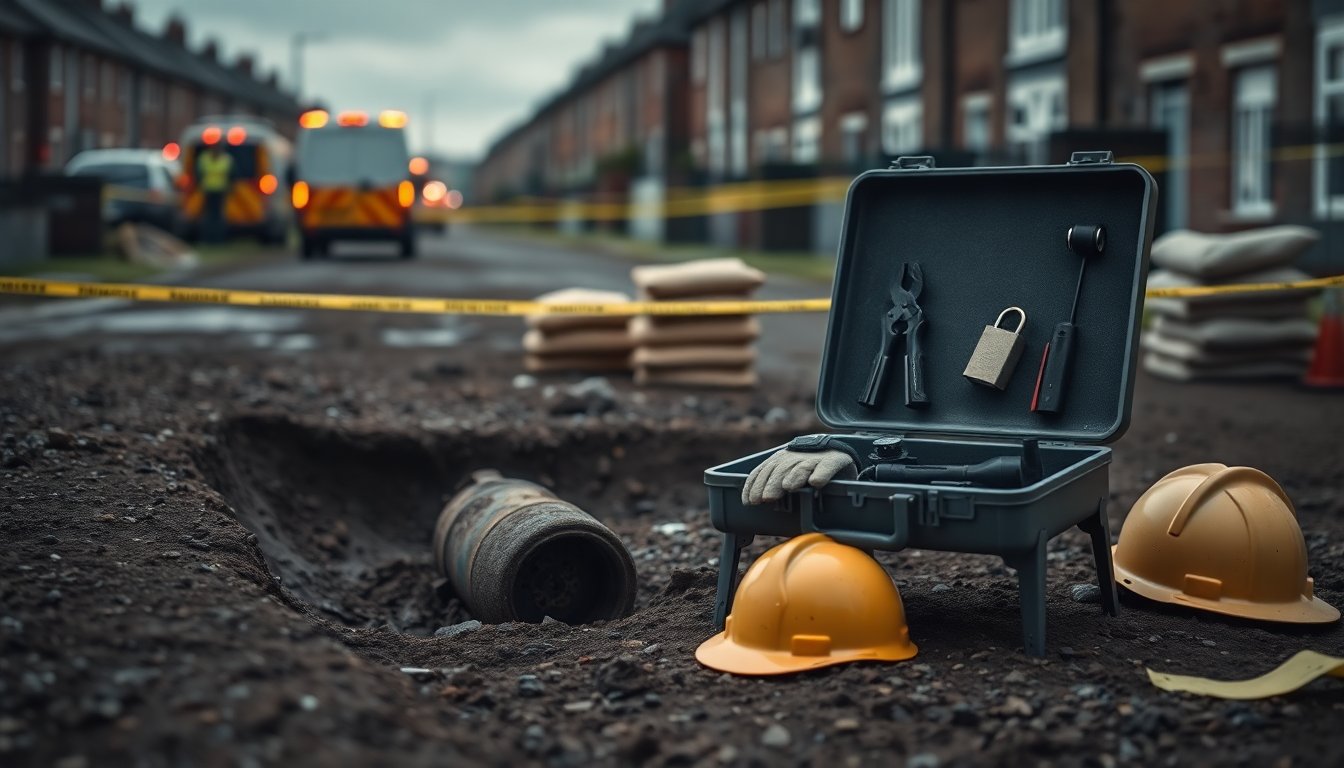
Fuze arrives as a compact exercise in tension, a film that wastes no time and asks viewers to keep pace. Director David Mackenzie opens with an immediate plunge into crisis: a World War II ordnance unearthed during construction in an English neighborhood sets the clock running. The story centers on Major Will Tranter (played by Aaron Taylor-Johnson), a bomb-disposal officer summoned to assess and, if possible, neutralize the weapon. Around him, a police cordon led by Chief Superintendent Zuzana (played by Gugu Mbatha-Raw) tries to manage evacuations and public safety as undercurrents of a separate crime ripple beneath the surface.
The film’s momentum is its defining trait. Screenwriter Ben Hopkins lays out parallel threads — the risky technical work of disposing of an explosive and an audacious burglary that exploits the chaos — and keeps both ticking forward. Mackenzie frequently employs a cinematic equivalent of an cold open, pushing viewers through a sequence of escalating obstacles with barely a lull. While the plot hinges on a handful of coincidences, the film’s propulsion and economy of detail mean the audience rarely has the luxury to dwell on them. The result is a taut ninety-eight-minute experience that feels like a single sustained surge toward multiple climaxes.
How the clock and the caper interlock
At the heart of Fuze is the interplay between two ostensibly separate emergencies: the fragile ordnance and the team of robbers tunneling toward a bank vault. The thieves, led by figures played by Theo James and Sam Worthington, use the blackout and distractions to drill into a neighboring vault in pursuit of uncut diamonds. Meanwhile, technical problems — groundwater, uncertain wiring, and an unreliable arming mechanism — complicate Major Tranter’s attempts to secure the device. The screenplay stages these converging problems so that every new attempt to resolve one crisis creates fresh jeopardy for the other. Such choreography keeps the film feeling like a well-engineered machine, where sequence and timing are the primary thrills.
Performance and directorial choices
Aaron Taylor-Johnson anchors the film with a compact, measured presence; his portrayal of a professional under pressure leans into restraint rather than melodrama. Gugu Mbatha-Raw supplies steady command as the police lead, while supporting turns from Theo James, Sam Worthington, and Elham Ehsas provide texture to the criminal side of the story. Director David Mackenzie favors clean staging and lean pacing over stylistic flourishes, treating action as a function of geography and timing. That approach amplifies the film’s procedural elements — the nuts-and-bolts of a bomb disposal mission — while allowing the caper sequences to morph into a chase and a tense hostage scenario.
Strengths: pacing and narrative economy
One of Fuze‘s biggest assets is its refusal to linger. The film’s spare architecture means almost every scene advances stakes or reveals a complication. The score often acts like a metronome, underscoring the sense of a tick-tock deadline, and editing stitches the multiple strands into a single forward thrust. When the film finally pauses to show consequences and pursue a manhunt and betrayals, it does so with the same briskness that governed the opening, which keeps momentum high and surprises frequent. The story is crafted so tightly that peripheral details rarely feel wasted; even apparent inconsistencies tend to serve a later pivot.
Criticisms: coincidence and an awkward coda
Not every gamble lands. Some viewers may find the accumulation of coincidences that propel late twists a little convenient, and a final epilogue that flashes back to earlier events feels like an explanatory addendum that slightly diminishes the film’s mystery. A few critics have argued that at times the film resembles high-end network television in its tonal restraint, and character depth is sometimes sacrificed for momentum. These choices will split audiences: those who prize pace and craft will welcome the tight construction, while others may wish for richer emotional plumbing or a more daring tonal swing.
Where Fuze sits in Mackenzie’s filmography
Fuze follows a series of films in which David Mackenzie has balanced genre mechanics with lean storytelling. This entry is less interested in moral binaries than in engineering suspense: it’s a study in pressure and timing, with splashes of betrayal and dark humor that complicate loyalties. Having premiered at TIFF 2026, the film lays down a compact, crowd-pleasing blueprint for viewers who enjoy taut, concentrated thrillers. It opens in theaters on April 24 and will likely find additional life on streaming platforms thanks to its brisk length and high rewatchability.
Ultimately, Fuze is a workout in cinematic tension: muscular, disciplined, occasionally flawed, and often exhilarating. If you favor movies that prioritize momentum and surprise over elaborate character study, this tight, genre-bending picture will likely satisfy. If you prefer deeper psychological digressions, the movie’s single-minded drive may feel like a missed opportunity. Either way, its craft — from Ben Hopkins’s plotting to the crew’s staging of set-piece moments — is unmistakable, and the film delivers a memorable, pulse-quickening ride.


