
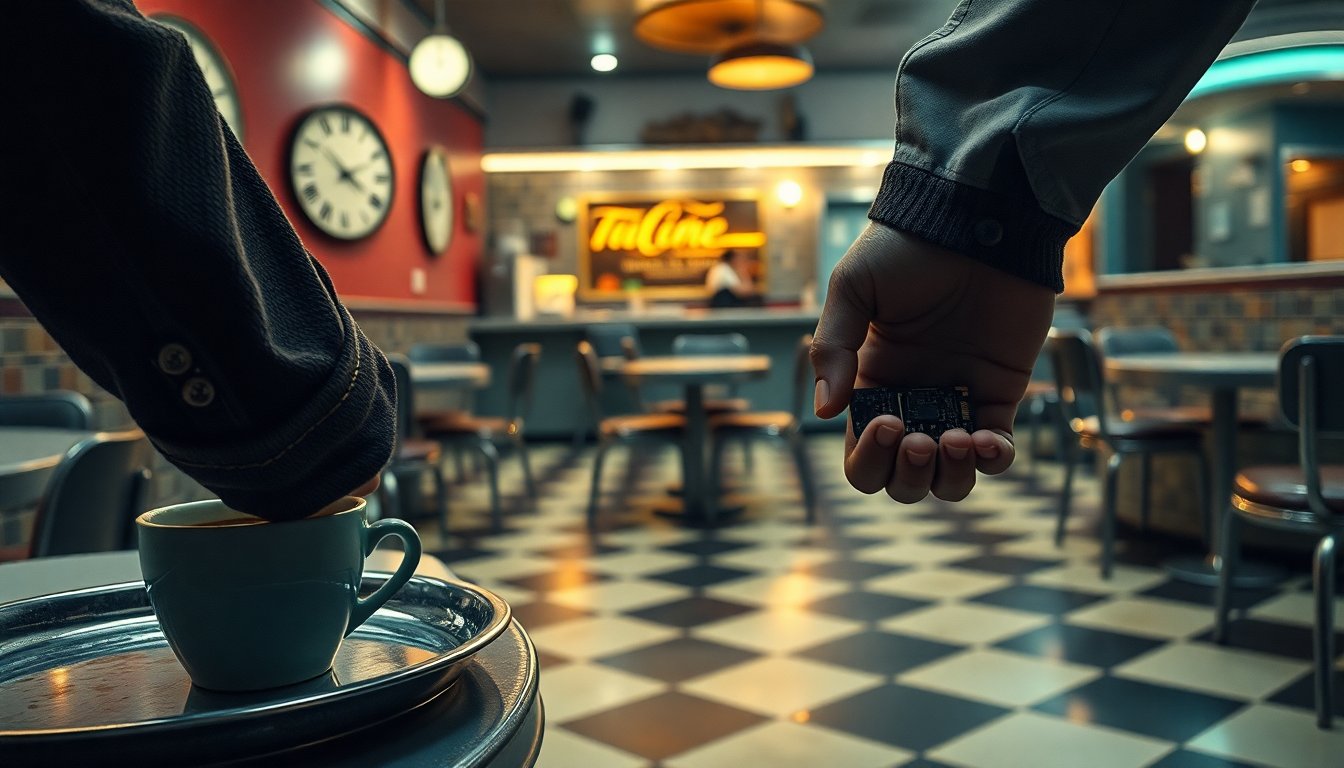
Gore Verbinski returns with a film that announces its intentions visually from the first frame. Good Luck, Have Fun, Don’t Die opens in a late-night diner and uses that small, familiar space as a stage for escalating, genre-bending chaos. What follows is not merely a story about an impending technological apocalypse; it is an exercise in cinematic design where color, light and camera movement are central storytelling tools.
The piece pairs a combustible lead performance with meticulous production choices: a time traveler (played by Sam Rockwell) who bursts into ordinary lives and recruits a ragtag group to stop an existential threat. The film balances satire and genuine grief, and it relies on a distinctive visual strategy to hold that balance without undercutting its emotional stakes.
Visual language as narrative engine
The movie treats imagery as more than ornament. Cinematographer James Whitaker collaborates closely with Verbinski and production designer David Brisbin to craft a color palette that both amplifies and undercuts the screenplay’s satiric barbs. Instead of obvious comedic cues, the team chose to play scenes with visual seriousness, letting the humor arise organically from performance and situation rather than visual wink.
Lighting choices are deliberately expressive: mixes of cyans and ambers, slices of artificial moonlight and practical LEDs are used to imply character histories. Whitaker described the aim as suggesting that each person has been emotionally bruised by modern life; the light itself becomes a shorthand for that interior damage. This approach turns the film into a study of how mood can be transmitted through cinematography and palette decisions.
The LED suit and collaborative problem-solving
One striking example of this collaboration is the protagonist’s costume, which incorporated functional LED elements. To keep those LEDs narratively useful rather than distracting, departments for costumes, props and lighting worked together to build and control them. That allowed the LEDs to act as a dynamic light source, shifting brightness and color to match exposure needs and emotional beats. The garment becomes an active part of the image rather than a passive prop.
Performance, tone and tonal balance
The ensemble — including Haley Lu Richardson, Michael Peña, Zazie Beetz, Asim Chaudhry and Juno Temple — navigates a script that alternates between dark tragedy and scabrous comedy. The actors were given the space to find the right emotional register on each take; on-set behavior and crew sensitivity were tailored to what performers needed, whether quiet for a raw moment or playful for a comedic beat. The camera, in Whitaker’s words, functions as a mirror: it adapts to reflect the actors’ chosen tone.
Many subplots carry heavy themes: loss, the normalization of violence, the effects of constant connectivity on human attention. One thread involves a parent coping with the aftermath of a school shooting, a subplot that requires tonal care so that satire does not become callous. In other scenes, the film skewers contemporary tech culture — imagining products and systems that deepen dependency while promising convenience — without resorting to simplistic parody.
Satire that aims for real emotional stakes
Rather than lampooning its subjects from a secure distance, the screenplay pushes characters into situations where consequences feel real and sometimes brutal. The time travel conceit and repeated attempts at recruitment create a rhythm that allows the film to examine urgency, responsibility and the ways we fail one another. The satire bites precisely because the film cares enough to make losses matter.
Scale, logistics and the climactic ambition
Though much of the film unfolds in intimate settings, the climax expands into a massive, elaborate confrontation with an algorithmic adversary. The production built large, complex environments — including substantial LED installations — and storyboarded the sequence extensively. Such planning allowed the filmmakers to execute ambitious camera moves and lighting setups on tight schedules while shooting primarily in South Africa and convincingly recreating Los Angeles interiors.
Verbinski’s directing approach combined deep technical knowledge with collaborative problem-solving. He often contributed solutions when the crew faced seemingly impossible challenges, and that hands-on leadership helped the production realize sequences that are physically and visually audacious.
For viewers, the film offers a blend of spectacle and introspection: a densely designed visual experience anchored by performances that shift between comic energy and human vulnerability. Good Luck, Have Fun, Don’t Die asks us to consider the cost of living tethered to screens and algorithms while delivering a uniquely styled cinematic ride. The film opens in theaters on Feb 13.