
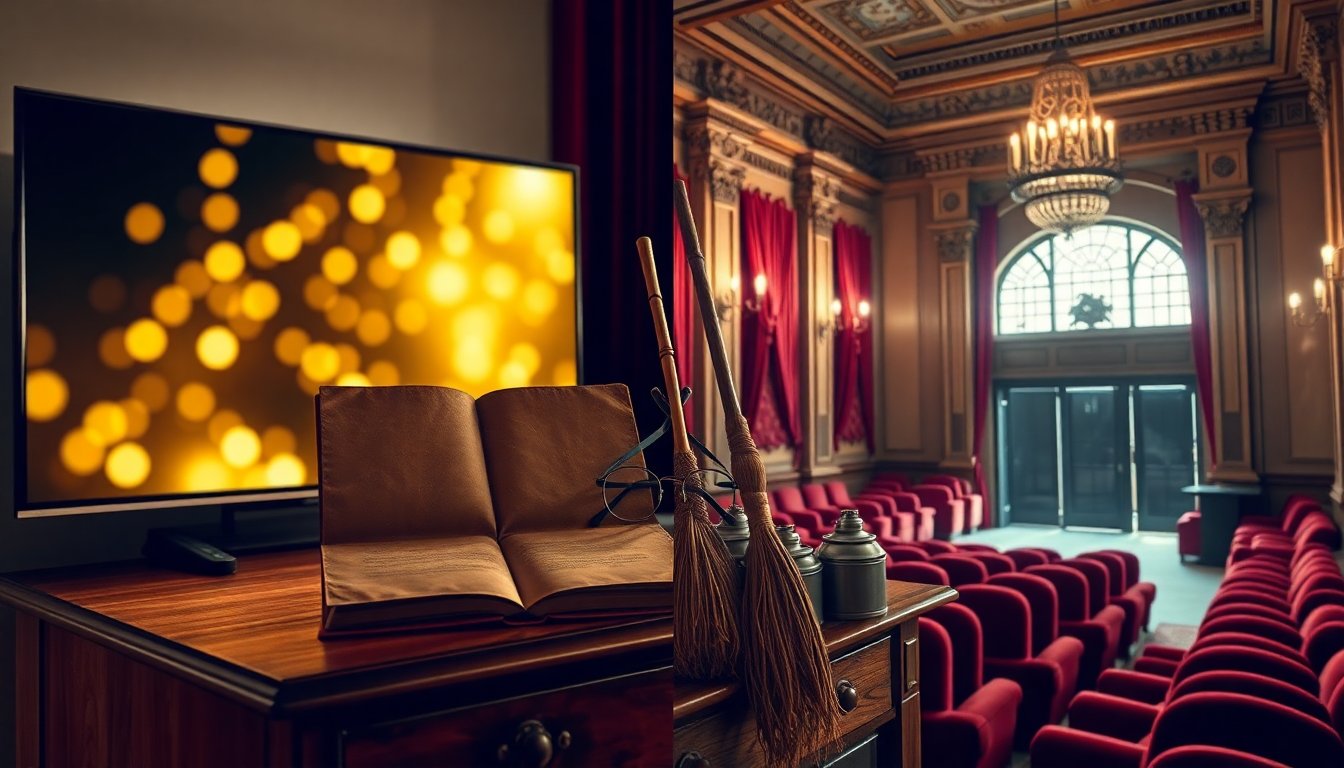
The entertainment landscape is witnessing an unexpected switch: two of Warner Bros.’ most valuable properties are exchanging their traditional homes. After years of success on the big screen and on premium television, Harry Potter and Game of Thrones are each taking a new direction that plays to the strengths of the other medium. This move reflects both studios’ efforts to refresh long-running intellectual properties and to meet audience demand for different storytelling rhythms.
Both franchises have extensive source material and large fan bases, which makes their strategic pivot especially noteworthy. The Wizarding World is returning to serialized television with the adaptation of the first novel, while Westeros is expanding into a feature-length treatment of a foundational historical event. These decisions were revealed through official studio communications and industry events, and they signal how legacy franchises can be reinvented for modern platforms.
Harry Potter moves to television
Warner Bros. and HBO announced that the first book, Harry Potter and the Philosopher’s Stone, is being reimagined as a television series, marking the franchise’s formal entry into episodic storytelling. The project is positioned not as a new tangent but as a careful re-adaptation of material familiar to millions. The plan is ambitious: a decade-long production has been mentioned so the studio can adapt all seven novels with the space each requires, and the aim is to offer a more faithful rendering of the books than previous films could provide.
Casting and format
The first season will consist of eight episodes and already has a release date set for December 25, 2026. HBO has released promotional footage that outlines the show’s tone and visual approach. The lead roles go to a fresh ensemble: Dominic McLaughlin as Harry, Alastair Stout as Ron, and Arabella Stanton as Hermione. Producers have framed the series as an opportunity to include scenes and characters that were necessarily trimmed from the film adaptations, leveraging the episodic format to deepen character arcs and worldbuilding.
Game of Thrones heads to cinemas
Conversely, the franchise that found its initial mass audience on television is preparing a major motion picture. Originating from George R.R. Martin’s novels and popularized on HBO beginning in 2011, Game of Thrones established itself as a television landmark despite a divisive series finale in 2019. The franchise later expanded on TV with House of the Dragon and A Knight of the Seven Kingdoms, but Warner Bros. confirmed at CinemaCon 2026 that a film titled Game of Thrones: Aegon’s Conquest is in development.
Source material and timeline
The announced movie will draw from Fire & Blood, the historical account within Martin’s world that chronicles the Targaryen rise. Studio materials place the film within their 2027 and beyond slate, suggesting an optimistic earliest release in 2027. By choosing a contained historical story, the franchise aims to deliver a cinematic narrative that complements ongoing television expansions while offering viewers a self-contained epic suitable for a single-screen experience.
What the swap means for both franchises
This cross-format strategy plays to each property’s strengths: television provides the space for Harry Potter‘s layered coming-of-age saga, while film offers Game of Thrones a concentrated arena for a grand historical event. The move also highlights a larger industry trend where studios tailor content format to story needs rather than forcing stories into legacy platforms. Success will hinge on execution: faithful adaptation, production scale, and audience reception will determine whether each franchise thrives in its new home.
Ultimately, fans and newcomers alike stand to gain if the adaptations respect the source material and use the chosen formats thoughtfully. The long-term futures of both universes will be shaped by how these initial projects perform, but the swap demonstrates a creative willingness to experiment with format to serve storytelling—and that could be a model for other franchises weighing television against theatrical ambition.


