
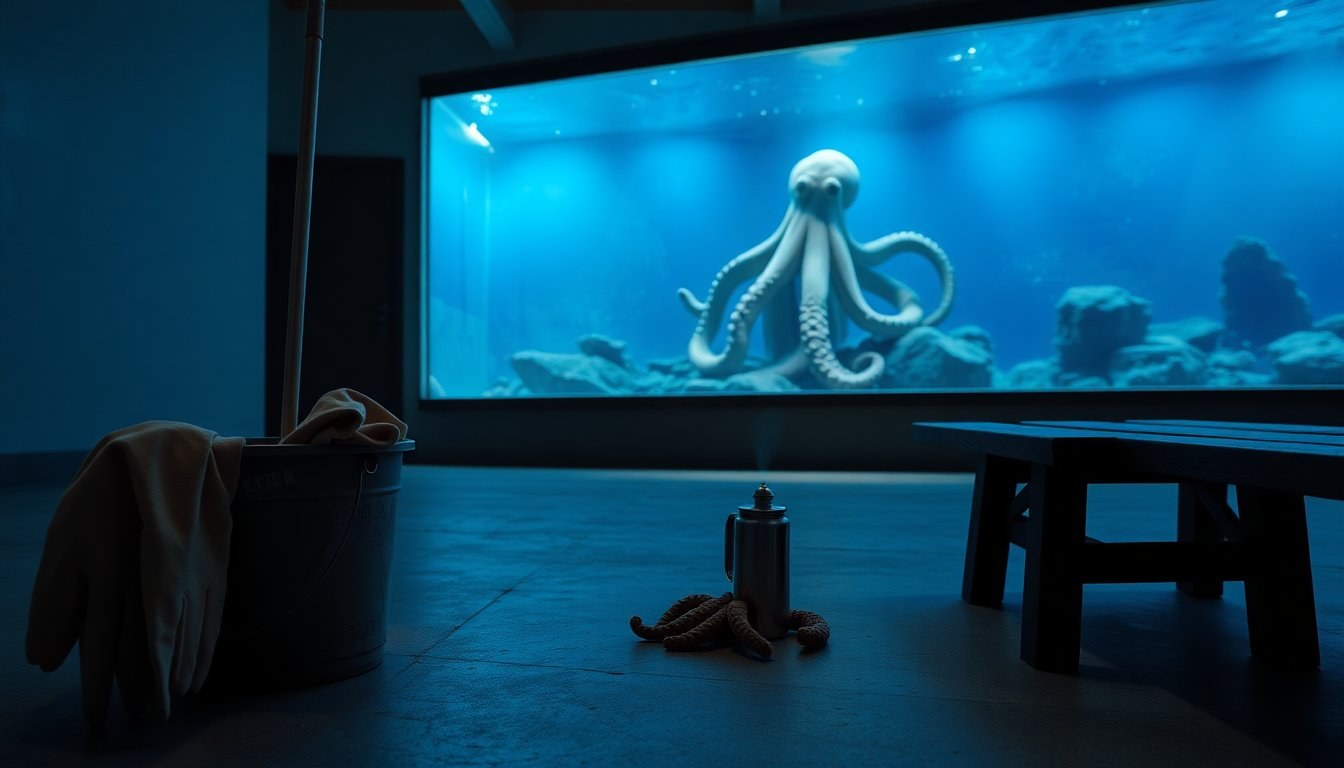
Olivia Newman’s film Remarkably Bright Creatures brings Shelby Van Pelt’s bestselling novel into a compact, screen-friendly shape while preserving its emotional center. The movie places Sally Field at the heart of the story as Tova, an aquarium overnight cleaner whose solitude is transformed by an unlikely companion: Marcellus, a giant Pacific octopus voiced by Alfred Molina. Lewis Pullman co-stars as Cameron, the adrift young man who arrives in the small town of Sowell Bay and becomes woven into Tova’s life. The picture premiered on Netflix, beginning streaming on May 8, 2026, and it balances sentiment with sly humor and an unusual narrative device.
From the start, Newman and co-writer John Whittington make deliberate choices about what to keep and what to condense. The screenplay trims certain backstories from the novel — tightening character histories and reframing some relationships — but those cuts are purposeful, designed to create a clear dramatic arc suited to a two-hour film. This is an adaptation that interprets the book rather than simply transcribes it, and the result is a film that feels faithful to the spirit of the source while standing on its own terms.
Adapting voice and structure for the screen
Newman’s central task was to find a cinematic spine: deciding where Tova’s journey begins and ends, and how other characters orbit that core. The production used the novel as a constant reference book, mining details for authenticity while condensing episodes into images and short scenes. Through thoughtful production design and selective dialogue, the film conveys backstory economically. The filmmakers relied on visual shorthand and performance subtleties to communicate long histories in moments. The result is a film that often prefers implication to exposition, using the camera and set pieces to replace paragraphs of prose with a single telling gesture.
Marcellus and the power of narration
The film preserves the octopus’s perspective by giving Marcellus a consistent voiceover, a strategy that translates the book’s chapters into a cinematic through-line. Molina’s delivery gives Marcellus a wry, knowing persona, lending both humor and pathos to scenes that might otherwise read sentimental. As framed in the movie, Marcellus is ingeniously clever: he explores his tank after hours, dodges notice, and observes human behavior with a sharp eye. Crucially, Marcellus understands Tova’s grief and loneliness — he overhears and internalizes her memories about her son Erik — creating an emotional bond that the film underscores through both narration and visual intimacy.
Performances that carry the film
Sally Field anchors the piece with a restrained, lived-in performance as Tova; she embodies quiet regret and stubborn affection without resorting to melodrama. Opposite her, Lewis Pullman brings a likeable, off-kilter charm to Cameron, a man searching for roots and purpose. Their chemistry is subtle and allows small moments to breathe. The ensemble — including Joan Chen, Kathy Baker, Beth Grant, Colm Meaney, and Sofia Black-D’Elia — fleshes out Sowell Bay as a community where everyone knows each other’s business. These supporting turns enhance the film’s sense of place and help make its emotional beats feel earned rather than manufactured.
Themes, setting, and emotional payoff
The film is preoccupied with family, second chances, and the ways communities keep people tethered. The aquarium and the surrounding Puget Sound region are not just backdrops but active elements in the narrative; the sea symbolizes freedom and loss, and the small-town environment amplifies the characters’ interconnectedness. Editing choices keep the pace deliberate, allowing late-act revelations to land with real weight. While the adaptation trims some novelistic detours — including certain early histories and extended character chapters — those omissions sharpen the story’s focus and heighten the warmth of intergenerational friendship at the center.
Overall, Remarkably Bright Creatures is a tender, often witty drama that succeeds by prioritizing character and tone. Its inventive choice to retain an octopus narrator and to cast strong performers leads to a film that is both heartfelt and clever. If you’re seeking a family-friendly title with emotional depth and a sly sense of humor, this Netflix adaptation is a solid pick. Critics have noted its careful adaptation work and the way it pares the novel to essential scenes; on balance, the movie delivers satisfying payoffs and memorable performances.


