
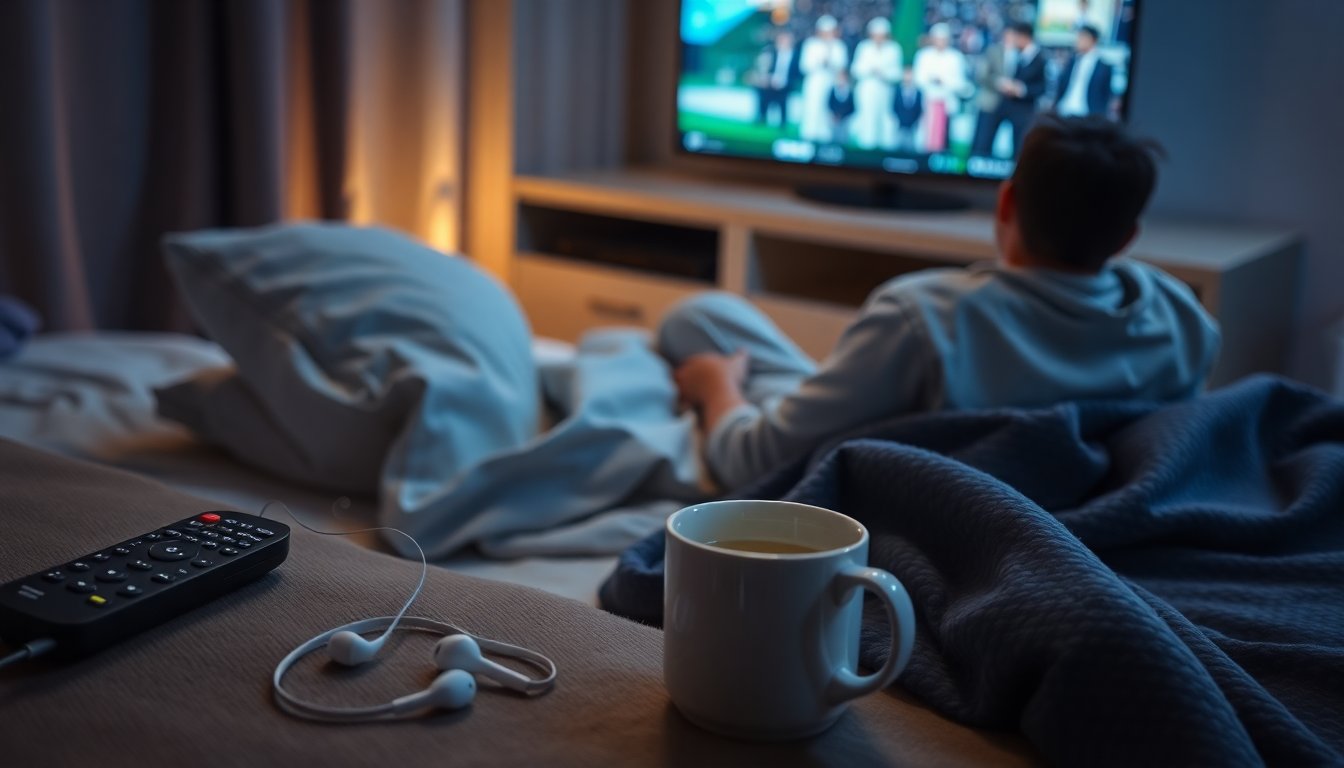
Falling asleep to the Academy Awards
Some viewers have repurposed televised ceremonies as a form of sleep aid. For many cinephiles and people with disrupted sleep, late-night replays of the Academy Awards provide a predictable sonic environment.
Orchestral cues, ceremonial envelope openings and measured acceptance speeches create a steady audio pattern. That pattern can reduce cognitive stimulation and produce a sense of calm for listeners.
In a media culture that treats awards broadcasts as single-use spectacles, replaying them after hours reframes pageantry as quiet background. The ritual transforms ambition and ceremony into what some describe as a televised lullaby.
The structure that lulls
The ritualized mix of staged comedy, live music and ceremonial announcements follows a fixed architecture. Producers rehearse timing and transitions to sustain pacing across multi-hour broadcasts. Those choices create recurring beats viewers come to expect.
Sequences alternate between high-energy moments and prolonged, low-stimulation passages. Acceptance speeches, musical cues and presenter banter are arranged to punctuate rather than sustain attention. The result is a cadence that soothes as it progresses.
Technical elements reinforce that cadence. Lighting and camera framing narrow focus during speeches. Orchestral swells and interstitial music smooth scene changes. Teleprompters and scripted jokes keep intervals predictable.
That predictability converts public spectacle into private soundscapes. Triumph and theatricality arrive in attenuated form. For some listeners, the ceremony thus functions less as live event than as ambient narrative suited to falling asleep.
Why live TV suits bedtime listening
The ceremony’s staged rhythm creates predictable arcs that ease cognitive load. Host jokes, musical cues and the cadence of envelope openings signal familiar transitions. That pattern reduces surprise and allows the brain to glide toward lower arousal.
Broadcast audio also contains long pauses and low-frequency sounds that blend into background noise. Ambient sections—orchestral swells, audience murmurs, and sustained applause—function as steady sonic textures. For many listeners, those textures act like a metronome for relaxation.
Another factor is narrative continuity. Even when attention lapses, the program maintains a coherent story: nominees introduced, awards delivered, brief acceptance remarks. That continuity satisfies the mind’s preference for structure without demanding active engagement.
Producers design the show to be followable at a glance. When the same design is encountered at night, it becomes a behavioral cue: settle in, divert attention, and drift. Listeners who prize ritual and repetition report the broadcast performs as an unintended sleep aid.
Listeners who prize ritual and repetition report the broadcast performs as an unintended sleep aid. The live ceremony combines fluctuating energy levels with a predictable progression of moments that ease cognitive effort. The Dolby Theatre textures—live orchestra swells, onstage timing and audience applause—provide acoustic variety absent from looped ambient playlists. Those textures substitute for the mechanical repetition of curated sleep tracks without sacrificing a coherent, stage-managed structure.
Personal examples and the 2004 ceremony
The night the listener missed the sweep
The listener described how a live awards broadcast can alternate between jolting peaks and soporific stretches. In this case, the 2004 Academy Awards settled into a steady cadence that lowered arousal rather than provoked it.
Sean Connery’s unexpected warmth in the opening moments and Billy Crystal’s characteristic hosting cadence contributed to that effect. Their tones remained measured and familiar, allowing the ceremony to recede into the background.
For this viewer, the ceremony’s pacing produced a sequence of low-intensity segments that blurred into sleep before major onstage moments demanded attention. The anecdote illustrates how individual responses to live events can transform a communal, high-profile broadcast into an unintended sleep aid without disrupting its stage-managed structure.
…responses to live events can transform a communal, high-profile broadcast into an unintended sleep aid without disrupting its stage-managed structure.
The 2004 ceremony provides a clear example. The Lord of the Rings: The Return of the King won 11 Academy Awards that night, creating a rare sweep that anchored the program’s narrative rhythm. Listening rather than watching traded visual detail for the show’s pacing and incidental cues. For some listeners, that trade-off permitted restorative rest without missing the
Practical tips and cultural context
Accepting audio-only attendance requires a few practical adjustments. Record the broadcast when possible to verify winners later. Increase or decrease volume to maintain comfort without disrupting sleep. Use program summaries from reputable outlets the following day for verification and context.
Broadcasts blend spectacle and filler by design. Acceptance of audio-only viewing exposes that structure: speeches and montages preserve a continuous cadence even when visuals are absent. That cadence can function as ambient sound for rest or as an accessible way to follow a long event while attending to other obligations.
Consider cultural implications. Awards ceremonies serve both as recognition rituals and as televised narratives curated for live audiences. When listeners foreground rest over real-time attention, they participate in a subtle reshaping of the event’s public meaning. Such choices reflect shifting audience habits in an environment of fragmented attention and competing commitments.
Practical notes for selecting and listening to broadcasts
Such choices reflect shifting audience habits in an environment of fragmented attention and competing commitments. For viewers experimenting with this method, a few practical steps improve results.
Search streaming platforms using targeted keywords to locate specific years or hosts. Older ceremonies can be difficult to find amid vast archives.
Prefer a year that features a host or presenters whose tone you find calming. Some hosts perform better in late-night listening because their delivery and jokes are less jarring in darker, quiet settings.
Pay attention to volume and device placement. Lower audio levels and placing a speaker across the room reduce the risk of abrupt awakenings from applause or sudden musical cues.
These measures aim to preserve the broadcast’s integrity while limiting disruptive elements. They also acknowledge how viewing contexts shape audience responses to live and recorded events.
How archived ceremonies change viewer engagement
They also acknowledge how viewing contexts shape audience responses to live and recorded events.
Beyond individual utility, archived broadcasts alter the cultural value of ceremonies. A programme made to energize a live audience often reads differently on replay. In that mode it functions more as a soundscape than as spectacle. The visual urgency of the live moment gives way to background texture.
That shift reframes mass ceremony as a private ritual. Viewers can treat recordings as flexible media to fit daily routines. For some, the change is mildly irreverent. For others, it is quietly reverential.
Practical consequences follow. Recorded ceremonies can ease viewing around work and family duties. They may also reduce the anxiety associated with keeping pace with live events. As broadcasters and platforms adapt, formats and archiving practices will shape how future audiences consume ritualised culture.