
The story of modern science fiction on television cannot be told without recognizing the catalytic role of Star Wars. When George Lucas released his space opera, it shifted studios’ appetites and the economics of genre entertainment, convincing networks to greenlight bolder projects. One of those projects was Glen A. Larson’s Battlestar Galactica, the original 1978 series that, while short‑lived, established visual and narrative ambitions later refined by the acclaimed 2003 reboot. Larson himself and his family credited Lucas’ success with proving that audiences would embrace large‑scale space adventures on screen.
Hollywood’s response to that cultural earthquake extended beyond story ideas to the very tools of filmmaking. Executives felt safer approving ambitious effects-driven series because Star Wars had created a pool of technicians and studios capable of delivering convincing spacecraft and battles. That practical expertise, involving people like John Dykstra and teams trained at Industrial Light & Magic, made it possible to translate cinematic spectacle into television budgets. At the same time, the similarity between the two properties triggered legal conflict, a reminder that imitation and inspiration can quickly blur in a commercial industry.
How Star Wars rewired television sci‑fi
Before Lucas’ film, many television science fiction projects leaned on theatrical concepts but lacked the technical infrastructure to sell them. Industrial Light & Magic (ILM) and its innovators brought new camera systems and miniature motion techniques into mainstream awareness, enabling shots that had previously been the exclusive province of big studios. Filmmakers also learned to think like engineers: controlling light, scale and motion to convince viewers that tiny models were real ships moving through vacuum. The production of the original Death Star sequences—developed at ILM in the mid‑1970s—demonstrated how careful model work, combined with inventive photography, could create an emotional pay‑off that studios knew audiences would pay to see.
That shift made networks more willing to gamble on ambitious television concepts. For Glen A. Larson, who launched Battlestar Galactica in 1978, the timing was crucial: studios were now familiar with the language of blockbuster effects and the craftsmen who executed them. This practical confidence allowed television to attempt a different kind of space saga than earlier shows had offered; while the aesthetic and tone were distinct from Lucas’ work, without the prior film’s market validation the TV series might never have cleared development hurdles.
The art and decline of miniature explosions
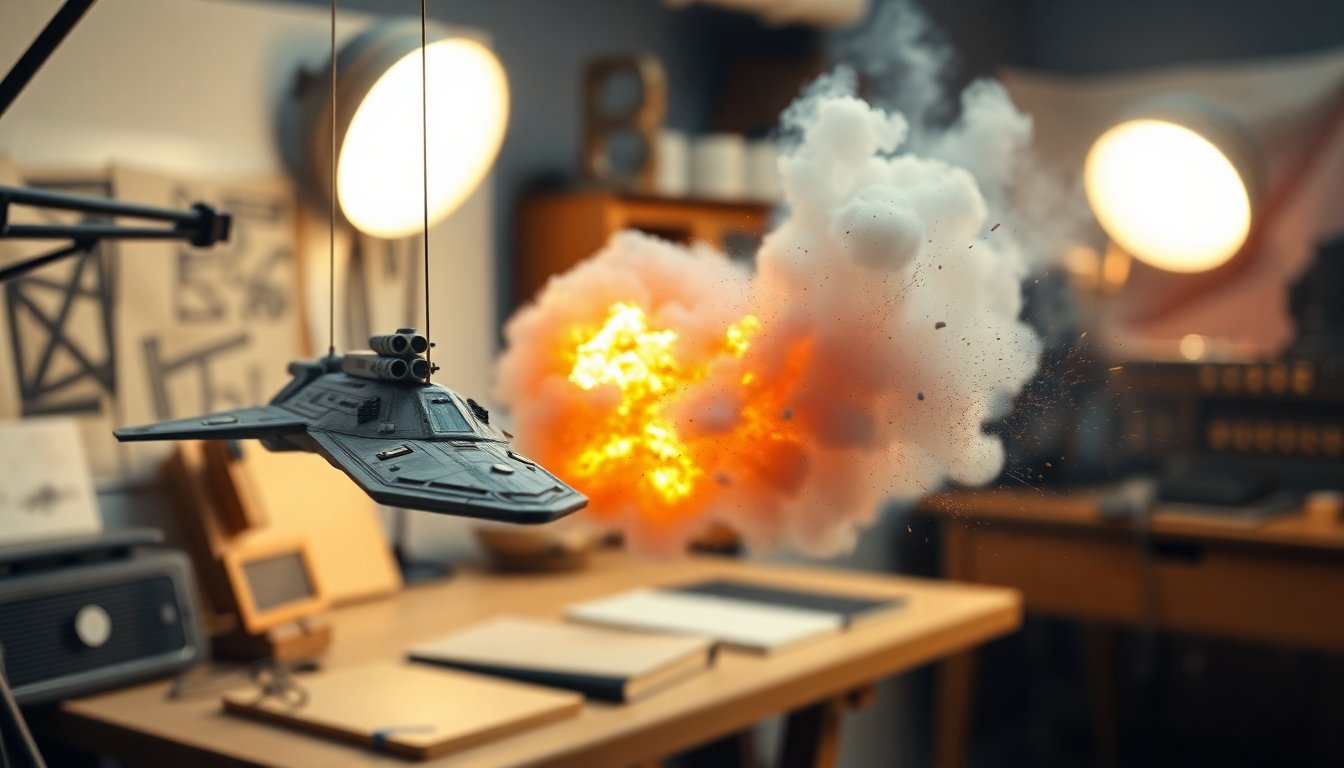
One of the most tactile skills born from that era was the miniature explosion: the careful detonation of scaled models and props to simulate catastrophic forces on screen. Specialists like pyrotechnician Joe Viskocil refined techniques to sell scale and zero‑gravity; for instance, shooting blasts from below to make debris appear to expand outward rather than simply fall, and standardizing colors and patterns so that destroyed craft read consistently on screen. Such decisions created a visual grammar that viewers came to accept as realistic within a fictional universe.
These methods reached spectacular peaks in later blockbusters. Viskocil helped craft the miniature White House destruction in Independence Day, using a 15‑foot model outfitted with tiny furniture to preserve believable interior detail during detonation. That sort of meticulous planning—mixing pyrotechnics, scale carpentry and camera technique—produced moments that digital effects now emulate. When Viskocil passed away in 2014, the industry lost a direct link to those practices, and over the following decades the once-common craft of physical miniature blasts became rarer as CGI matured.
Where the legacy lives on
Although full miniature explosions are far less common today, their influence persists. Directors like Christopher Nolan continue to favor practical elements alongside digital work, and ILM still deploys models in hybrid workflows. Streaming era productions such as The Mandalorian have used physical models—like the Razor Crest—for tactile reference even when the final destruction sequence relied largely on CGI. The Mandalorian and Grogu is scheduled to hit theaters on May 22, 2026, a reminder that franchises keep returning to both old and new techniques when storytelling demands it.
Ultimately, the chain from Star Wars to Battlestar Galactica and the era of miniature pyrotechnics illustrates how one breakthrough can reshape an entire medium. Studios, technicians, and audiences adapted to a new visual standard, and while many hands‑on effects have faded, their lessons continue to inform contemporary VFX practices. For viewers curious about origins, the original Battlestar Galactica remains accessible on home video, offering a window into a moment when television first dared to mirror the scale of cinematic space opera.