
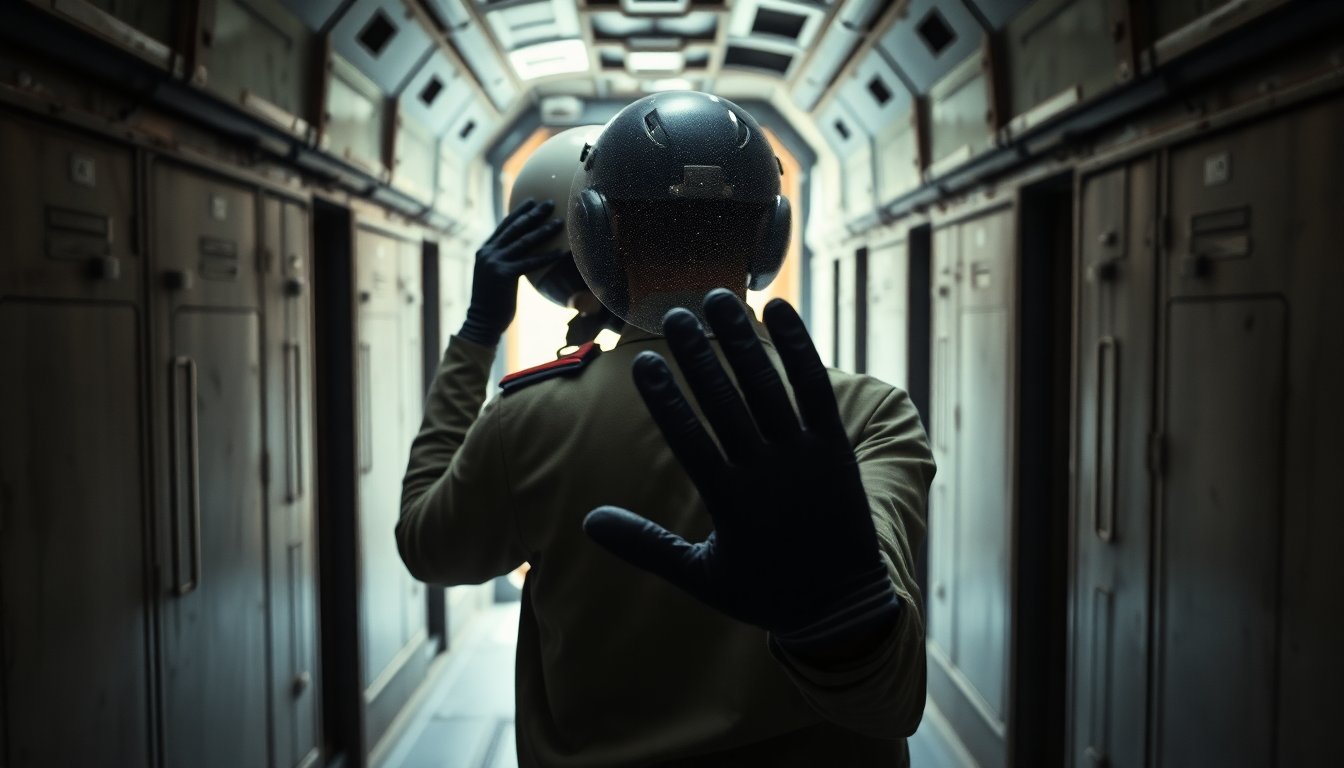
Star trek: starfleet academy leans on an old visual idea while darkening its tone
The latest episode of Star Trek: Starfleet Academy, titled “Come, Let’s Away,” reconnects the franchise to a familiar visual motif while steering the series into grimmer narrative territory. The story unfolds during 32nd century reconstruction after The Burn. It mixes cadet life with immediate starship peril.
On a routine training mission aboard the derelict U.S.S. Miyazaki, a simulated exercise escalates into a real life-or-death struggle when an antagonistic alien group called the Furies attacks. The sequence raises the stakes for the cadets and shifts the episode from classroom drills to survival drama.
Observant viewers also noted a small technological callback. Cadets use shimmering personal protective fields rather than bulky suits when they beam into vacuum. That effect is practical and aesthetic. It deliberately evokes the yellow, glowing personal force fields first seen in Star Trek: The Animated Series, a show that allowed the franchise to explore bolder visuals and stranger aliens.
I’ve seen too many reboots promise bold visuals and deliver safe choices. This episode chooses a visible, craft-driven nod to franchise history while committing to a darker story line. The result foregrounds immediate danger and a restrained use of classic franchise imagery.
How the Miyazaki mission reframes cadet training
The latest episode centers on a training exercise aboard the decommissioned Miyazaki, a starship damaged by a failed singularity drive attempt during the Burn. Cadets from the Academy and the War College are ordered to reactivate the vessel within a tight window. The routine drill escalates when the Furies board the ship, turning the simulation into real danger.
Who: Academy and War College cadets, supported by an onboard AI and a remote command center. What: an exercise to bring the damaged Miyazaki back online that becomes a live rescue and containment operation. Where: aboard the Miyazaki and in a coordinated command facility. Why: the narrative uses the mission to examine institutional fragility and the human cost of past catastrophes.
The episode balances tactical improvisation with personal strain. Cadets jury-rig the ship’s fragmented systems under pressure. The onboard AI provides diagnostics and procedural guidance, while the command center manages evacuation and rescue sequencing. The story highlights how training can blur into survival when systems and timing fail.
Stylistically, the sequence shifts the show’s tone away from glossy nostalgia. The visuals reuse familiar franchise motifs but keep them muted. The result underscores immediate peril and a restrained use of classic imagery, reinforcing a Federation still recovering from systemic collapse.
I bring a product-minded lens to the scene. Anyone who has launched a product knows that stress tests reveal hidden failure modes. The Miyazaki mission functions as a stress test for both hardware and culture. Growth data tells a different story: the episode measures cadet readiness by their ability to contain cascading failures, not by heroic set pieces.
Two clear lessons emerge for the show’s internal logic and for storytelling. First, realistic training must expose institutional blind spots. Second, character stakes gain credibility when technical failures have tangible emotional costs. The episode uses procedural detail to raise the narrative stakes without resorting to melodrama.
Case material from the mission anchors the plot in concrete choices. Command prioritizes life support triage over ship restoration. Cadet teams split responsibilities between system stabilization and casualty care. These decisions illustrate trade-offs that define both command competence and moral judgment.
The episode ends on an uncertain note, emphasizing recovery over triumph. It reframes cadet training as an exercise in managing aftermaths as much as mastering systems. That framing keeps the series grounded in the operational realities of a rebuilding Federation.
The return of personal force fields and their lineage
That framing keeps the series grounded in the operational realities of a rebuilding Federation. The cadets’ glowing suits channel a familiar visual language. They owe a clear debt to an earlier animated artifact where crew members used yellow, translucent force fields as energy-based spacesuits.
Why bring that motif back now? Partly for visual shorthand. Personal force fields instantly signal protection and isolation without lengthy exposition. They also let production teams suggest advanced technology without expensive rigging or complex effects.
Anyone who has launched a product knows that nostalgia can be a low-effort vector for audience recognition. I’ve seen too many franchises chase novelty and forget the core trade-off: does the device serve the story or merely decorate it? Here, the suits mostly do the former. They reinforce the training scenario’s stakes while echoing franchise history.
Stylistically, the choice bridges eras. The animated series used the fields as a production-friendly solution. The live-action return reframes that solution as plausible kit for cadets operating on a patched-up ship. Growth data tells a different story: visual callbacks rarely satisfy viewers unless they also advance character or plot.
Practically, the sequence asks a narrower question: can a familiar prop carry new narrative weight? The episode answers by integrating the suits into training drills and operational constraints. That keeps the nod to the past from feeling like mere fan service and ties the visual motif to the episode’s themes of repair and readiness.
Practical production reasons and in-universe logic
That keeps the nod to the past from feeling like mere fan service and ties the visual motif to the episode’s themes of repair and readiness. On set, the decision reflects simple production calculus: modern visual effects reduce the marginal cost of a shimmering personal barrier. Contemporary VFX pipelines render translucent energy fields convincingly without costly practical rigs.
In narrative terms, the series is set far beyond the original timeline. That passage of fictional time provides a plausible diegetic reason for revisiting and normalizing the technology. Writers can attribute the revival to incremental advances in miniaturized life-support and portable shielding, not sudden magic.
Starfleet Academy outfits therefore serve dual purposes. They signal institutional preparedness to viewers and they embody a credible technological progression within the story. The effect also makes tactical sense for cadets operating in hazardous, post-conflict environments.
I’ve seen too many startups fail to sell a product solely on nostalgia, and the same pitfall applies to revived tech in fiction. Growth data tells a different story: audiences accept a throwback when it emerges from clear, functional needs within the plot. Anyone who has launched a product knows that plausibility beats spectacle when sustainability is the goal.
Production teams balance those demands by using layered visual and sound design cues. A faint hum, practical costume elements, and controlled CGI pulses make the fields read as engineered systems, not mere costumes. That treatment preserves dramatic stakes while integrating the device into routine operations.
On-screen, the result is a modest visual shorthand. The shield becomes a narrative tool for training scenarios, emergency responses, and character-driven lessons about risk management. Expect subsequent episodes to test limits and reveal logistical trade-offs, such as power consumption and maintenance, rather than present the technology as flawless.
On set, crew favored a translucent personal field because it preserves character visuals and removes the need for bulkier suits. The choice simplified choreography and reduced costume time. It also aligned with earlier animation techniques that achieved similar clarity without heavy gear.
Within the story, writers presented the fields as logical, incremental advances. They act as more efficient transporters, personalized badges and advanced holographic interfaces. Those elements mirror developments the franchise has explored elsewhere, which supports the notion that personal shielding could be standard issue in the 32nd century.
From playful animation to canonical acceptance
The glowing fields represent a small but telling convergence. A visual flourish first used in a cartoon context has been assimilated into the broader Star Trek mythos. It follows a pattern: speculative ideas introduced in earlier formats later reappear as accepted technology.
Anyone who has launched a product knows that aesthetic choices often carry functional consequences. Here, a design decision solved production constraints while supplying plausible in-universe utility. It also offers writers a tool to explore trade-offs such as power consumption and maintenance in future episodes.
Interwoven drama: character losses and moral complications
Following the episode’s technical focus on field design and maintenance trade-offs, the narrative shifts emphatically to human consequences. The boarding attack kills several supporting figures, including a chaperone officer, and a respected cadet dies during the assault. The sequence underscores tangible costs: casualties are immediate, responses are disordered, and reaching compromises with morally questionable partners becomes necessary.
The events take place in a rebuilt galaxy where political power is fragmented. The episode portrays the Federation as contested rather than dominant. Commanders negotiate under pressure, and tactical decisions carry clear moral weight.
I’ve seen too many productions gloss over collateral damage. This episode does not. It shows messy aftermaths: grieving units, strained chains of command, and political bargaining that blurs ethical lines. Growth data tells a different story: dramatic stakes can drive engagement, but only if consequences feel real.
The sequence creates narrative momentum. It raises questions about leadership, alliances and the cost of security in a fragile order. Anyone who has launched a product knows that trade-offs demand honest accounting; the writers apply the same discipline to storytelling here.
The immediate effect is to complicate future decision‑making on screen. Losses prompt political deals with dubious actors and force characters to balance survival against principle—an arc likely to shape coming episodes.
Rescue mission complicates plot with moral and tactical trade-offs
Who: the episode’s cast and creative team stage a rescue that forces principal characters into fraught negotiations with unsavoury partners. What: the mission intertwines diplomatic compromise, covert technologies and telepathic methods deployed under extreme pressure. Where and when: the action unfolds across contested star systems and in clandestine settings within the episode’s timeline. Why it matters: these choices deepen the stakes and reframe the narrative around survival and accountability.
High-caliber performers give the confrontations weight that dialogue alone could not sustain. Their work converts procedural beats into human drama, making political deals and tactical gambits feel consequential rather than perfunctory. Anyone who has launched a product knows that execution makes or breaks an idea; in television, execution likewise determines whether an homage reads as meaningful or merely decorative.
One visual callback, the reintroduction of personal force fields, illustrates that point. The device operates on two levels: as a nod to franchise continuity and as a marker of technological evolution within the story world. The effect is not merely aesthetic; it anchors debates about resource allocation, ethics and long-term recovery in concrete, in-universe terms.
I’ve seen too many ventures trade substance for nostalgia, and this episode avoids that pitfall by tying spectacle to consequence. Growth data tells a different story: when production choices reinforce thematic coherence, viewership and critical engagement follow. The sequence therefore functions as both a technical salute to franchise history and a sober portrait of a fragile interstellar order.
Losses on-screen prompt alliances with dubious actors and compel characters to weigh immediate survival against moral principle. That tension promises to shape forthcoming episodes and the series’ broader arc around rebuilding, loss and the ethics of survival in a dangerous century.