
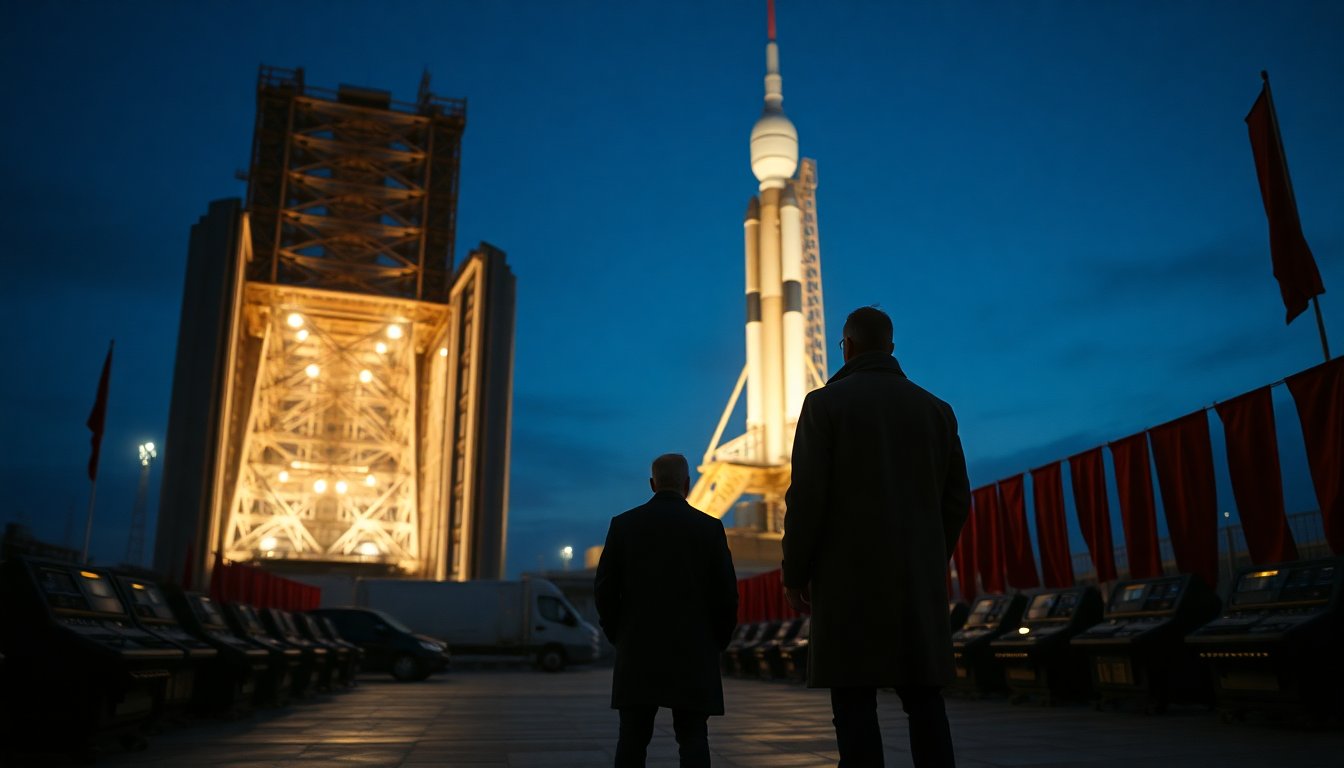
The creative team behind For All Mankind has turned its focus eastward with Star City, an eight-episode alt-history drama that explores what happens when the Soviet Union claims the moon first. Writers and showrunners Ben Nedivi and Matt Wolpert, alongside co-creator Ronald D. Moore, brought the series to the world stage at the Canneseries world premiere on April 26. The pair have said that recent real-world events, including the Artemis II launch, reignited the collective enthusiasm for exploration and helped shape their approach to telling this story.
Functioning as a companion to its predecessor, Star City reframes the familiar space race from the viewpoint of cosmonauts, engineers and intelligence officers based inside the Soviet program. The series debuts globally on Apple TV with two episodes on May 29, followed by weekly drops through July 10, and is produced for the streamer by Sony Pictures Television. The ensemble includes Rhys Ifans, Anna Maxwell Martin, Agnes O’Casey, Alice Englert and Solly McLeod, among others.
Origins and creative intent
At the heart of Star City is an intention to reclaim a sense of wonder around human exploration while interrogating the costs of triumph under an authoritarian system. Nedivi and Wolpert describe a cultural exploration gene that compels societies to push outward, but they also stress the moral and human compromises that accompany state-driven achievement. The writers treat the show as a study of people living within a system: proud, fearful and constrained. That tension between pride in technological feats and the personal restrictions imposed by the regime is a through-line, and it informs the characters’ arcs as much as the show’s spectacle.
Production, premiere and global rollout
The series is notable for its international footprint: although it is performed in English, much of the production took place in Lithuania, evoking the look and atmosphere of the Soviet period. The creative team has cited the miniseries Chernobyl as an influence for the production choices that lend authenticity and scale. Apple’s confident commissioning allowed the creators to tackle politically sensitive material without reducing the series to a commercial calculation, and the Canneseries premiere on April 26 underscored the show’s festival-level ambitions before the Apple TV launch on May 29.
Casting and performances
Star City assembles a cast that spans film, television and stage: Rhys Ifans and Anna Maxwell Martin lead a roster that includes Adam Nagaitis, Ruby Ashbourne Serkis, Josef Davies and Priya Kansara. The actors portray individuals whose public identities are carefully managed by the state—speeches are written for them, personal choices are scrutinized, and even marriages can be arranged. The series leans into those constraints to dramatize how celebrity and surveillance intersect inside a program that both idolizes and imprisons its heroes.
Filming locations and international scope
By shooting in Lithuania and engaging a multinational crew, the production aimed for cultural specificity. Many crew members grew up with memories or family stories shaped by Soviet rule, and their perspectives informed costume and set design in ways that the creators found essential for authenticity. Apple’s support allowed the series to remain true to its dramatic aims: to show an uncompromising portrait of a program that advanced science while enforcing conformity.
Themes, history and narrative devices
The writers draw freely from real historical episodes and reshape them to fit the show’s alt-history premise. Episodes nod to real figures and events—such as the perilous landing of a cosmonaut like Alexei Leonov in a Siberian forest and the real-life arranged marriage of Valentina Tereshkova—to anchor the drama. These moments illustrate the show’s recurring idea: life on the ground can be more dangerous and morally fraught than the raw risks of spaceflight. The Soviet secrecy around its achievements supplied the writers with dramatic material, from reported survival tales to state-controlled celebrity, all used to build suspense and political texture.
Espionage, ideology and human resilience
Star City mixes the paranoia of spy drama with the emotional stakes of human stories. Plotlines include intelligence operations, internal surveillance and the personal toll exacted by a system that prizes victory at the expense of individual freedom. Yet the show also foregrounds resilience: Nedivi and Wolpert emphasize that despite oppression, characters find ways to preserve dignity, speak out and push for cooperation beyond borders. The creators have argued that science and shared facts can reduce enmity, a hope threaded through the series’ depiction of collaboration across ideological lines.
Why it matters now
Set against contemporary geopolitical anxieties, Star City functions as both a cautionary tale and an affirmation of curiosity. In a moment when space exploration once again captures global attention, the series asks what we sacrifice to be first and whether technological progress can coexist with human rights. With festival exposure on April 26 and a full Apple TV rollout starting May 29, the show positions itself as a conversation starter about ambition, control and the enduring human urge to reach beyond our planet.


