
The television adaptation It: Welcome to Derry continues to grow its creative footprint as showrunner and director Andy Muschietti teases what comes after the first season. Building on the foundations of Stephen King’s sprawling novel, Muschietti and his team are mining small but potent passages of the source text to construct new, self-contained arcs. Rather than repeating material covered by the films, the series is choosing to expand the world in time and tone, with season 2 set to head into the year 1935 and explore a violent subplot known to readers as the Bradley Gang.
That decision reflects a deliberate strategy: adapt the emotional and thematic bones of King’s work while creating fresh set pieces and mysteries for viewers. The creative leaders — including executive producers Andy Muschietti and Barbara Muschietti, plus showrunners Jason Fuchs and Brad Caleb Kane — have signaled that the series will keep unfolding backward through time. That approach ties directly to a central conceit about Pennywise: the entity does not perceive time in the same way humans do, and the show will use that idea to generate suspense even when an endpoint is already known.
Season 2 focus: the Bradley Gang and 1935 Derry
The upcoming season centers on the incident King tucked into the novel: a gang of bank robbers who stop in Derry and encounter something catastrophic. On screen the subplot will be reimagined as the Bradley Gang, a violent episode that the writers plan to render as a massacre — a pivotal and shocking event in the town’s history. This storyline is lifted from an anecdote in the book and echoes a real-life crime that influenced King: the Brady Gang, known for a public execution in Bangor, Maine. Translating that grim kernel into a serialized, character-driven hour of television is part of the series’ mission to illuminate corners of the mythos the films did not and could not fully examine.
Source material and real-world echoes
King’s original 1986 novel contains many such fragments that suggest larger narratives without resolving them. The production team has treated those fragments as starting points: each tiny suggestion in the book becomes a scaffold for an expanded plotline on television. The historical inspiration — the real Brady Gang incident — gives the show latitude to weave true-crime atmosphere into the supernatural, making the town of Derry feel haunted by both human cruelty and an older, stranger evil. That interplay is one of the show’s aims: to have human horror amplify the terror of Pennywise.
Depression-era Derry and tonal shifts
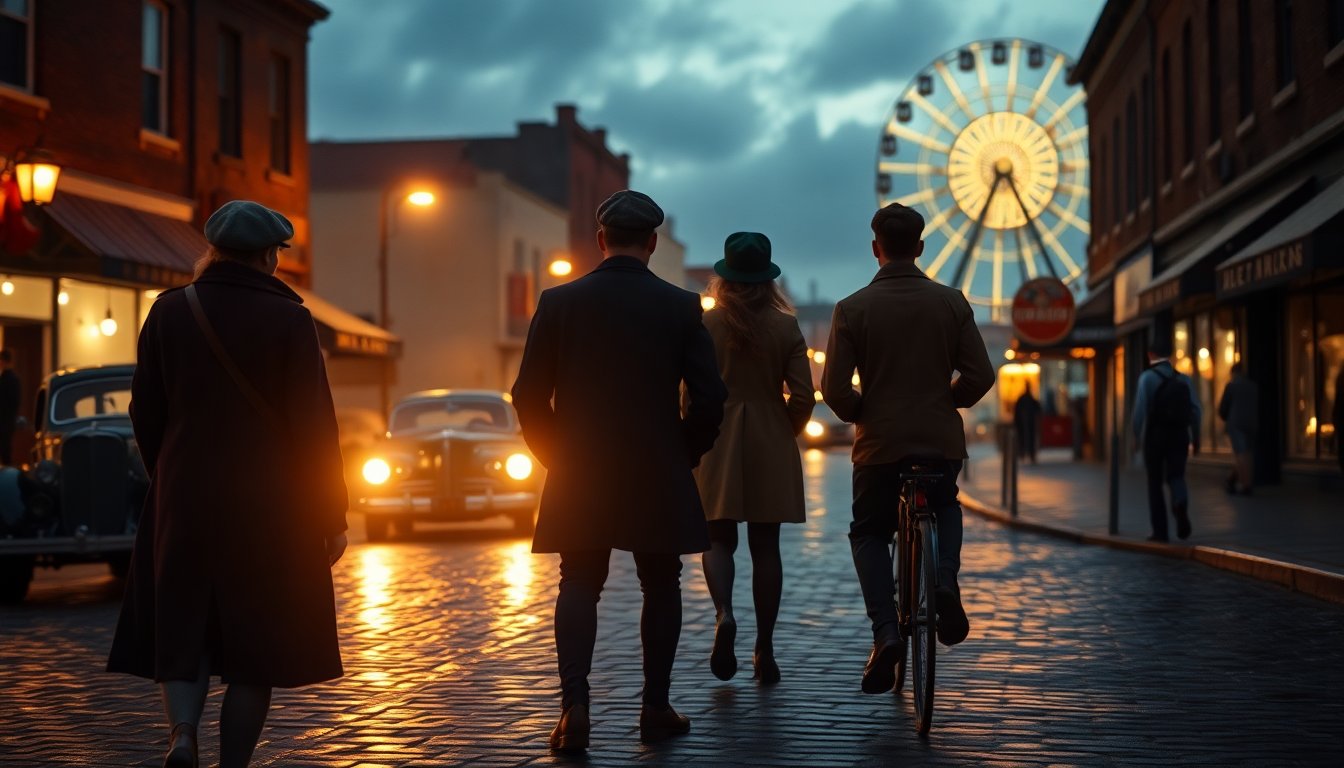
Moving the action to 1935 changes the visual and social landscape: this is the Depression Era, a time when many families struggled to survive and the comforts of postwar suburbia were absent. Expect a grimmer, more desperate Derry where children and adults confront scarcity as well as supernatural danger. Muschietti has described the era as one that reshapes the setup for fear: the kids won’t be biking through safe cul-de-sacs; they’ll navigate a tougher, more precarious environment where tragedy and violence are amplified by economic hardship. That shift serves to make the prequel feel distinct while remaining faithful to King’s themes.
Time, origin and the expanding threat of Pennywise
A core idea driving the backward-moving structure is the series’ interest in how Pennywise experiences time. The show leans into the notion that the creature perceives the past, present and future simultaneously — a concept the team has framed as non-linear time. By telling parts of the story earlier in the monster’s own timeline, the writers hope to create dramatic tension even though viewers may already know key outcomes, such as the creature’s fate in 2016. This temporal play allows the series to ask new questions about origin and identity: how did Bob Gray become Pennywise, and what capacities does the being wield when it can move across time?
The series has also begun to tease connections back to the films and the wider Losers’ Club mythology. One notable reveal in season 1 established that the character Marge carries traits that link her to Richie Tozier, a story decision intended to create emotional resonance across different eras. That kind of cross-generational echo — creating a throughline between new characters and established ones — underlines the show’s ambition to be both an independent serial and a complementary piece to the cinematic adaptations.
Production signals and what lies beyond season 2
Behind-the-scenes signals suggest the team is already thinking about a multi-season arc: Muschietti has mentioned a potential season 3 that would dramatize the Kitchener Iron Works explosion — a devastating event tied to an Easter egg hunt in the novel — where many children perish. Social media teases, like a red balloon posted by co-showrunner Brad Caleb Kane, have sparked fan speculation that renewal announcements may be imminent. Whether by formal confirmation or creative breadcrumbs, the producers are clearly mapping a trajectory that spans eras and expands the series’ mythological scope.
Fan implications and franchise continuity
If the plan proceeds, viewers can expect younger versions of familiar figures alongside entirely new characters introduced to populate earlier decades of Derry. The producers have said their original pitch to Stephen King involved telling the larger story backwards — an idea that motivates both narrative choices and character links. By balancing fresh arcs like the Bradley Gang massacre with connective tissue to the films, the show seeks to deliver surprises while honoring the source material.
In sum, the next chapters of It: Welcome to Derry promise a darker, historically rooted exploration of the town’s horrors, a closer look at Pennywise as a temporal predator, and continued efforts to fold Stephen King’s scattered hints into full-season narratives. For fans of the book and the films alike, the project aims to make the familiar uncanny again by reversing time and illuminating untold moments of dread.


