
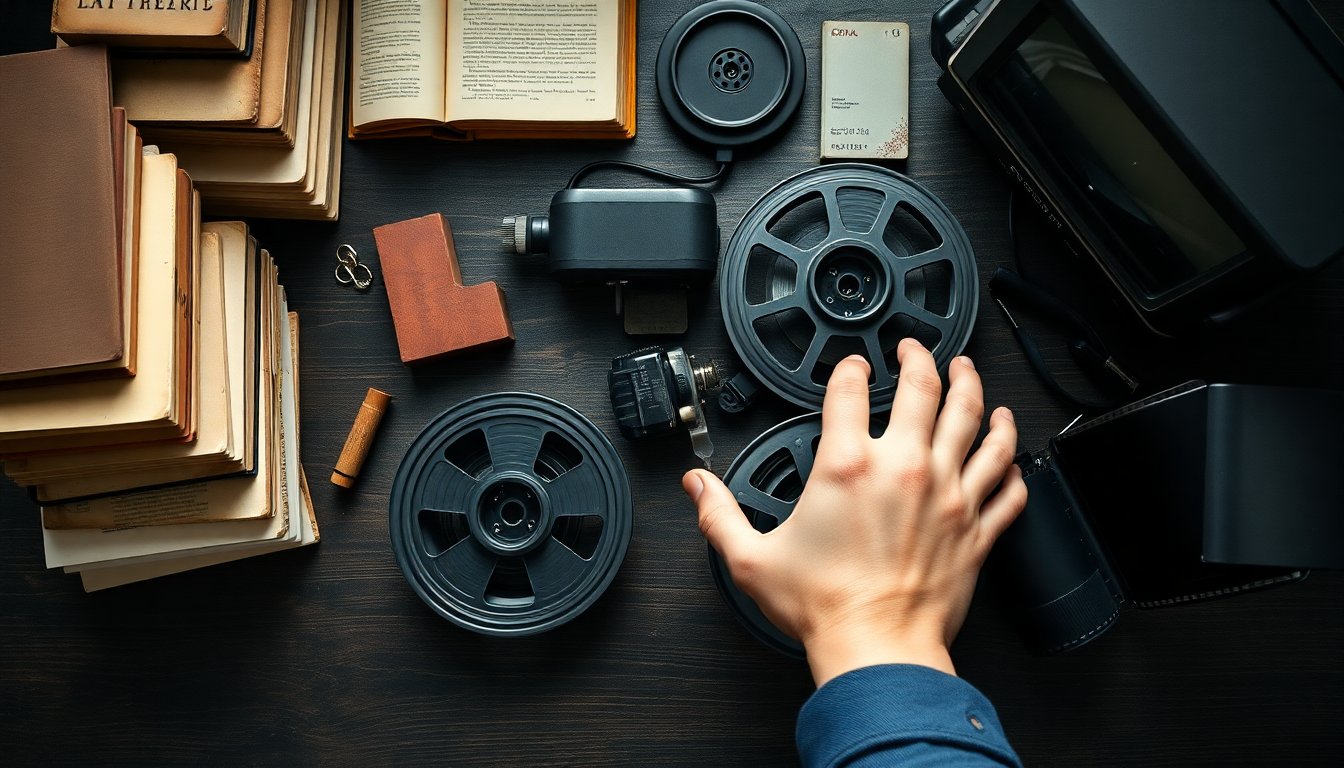
Books and restorations that reframe film history
The palate never lies: this roundup tastes the recent crop of books and deluxe home-video releases that map contemporary film culture. It gathers new biographies, photo monographs, oral histories, and technical studies alongside notable 4K and Blu-ray restorations. The pieces illuminate major filmmakers, leading actors, composers and the craft of moviemaking.
Who: critics, archivists and scholars who produced these titles and restorations. What: a selection of recent volumes and special-edition discs that offer fresh context or preserve fragile film heritage. When: newly released or newly reissued works appearing now. Where: international publishing and home-video markets that serve collectors and public libraries. Why: these releases reframe familiar narratives, recover lost material and restore texture, sound and context to classic and cult films.
Expect profiles that balance industry anecdotes with personal reflection, analyses that reconsider well-worn eras, and artful volumes that foreground photography and design. Some books offer sweeping cultural context; others deliver intimate storytelling or technical scholarship on restoration and film music.
As a former chef I learned that details matter. Here the evidence is tactile: a restored film print that regains its grain, a score annotated with production notes, a portrait book that reveals an actor through candid frames. Behind every item there is a story of discovery, preservation and editorial choice.
Profiles of cinema’s power players
The palate never lies, and that sensibility guides Paul Fischer’s examination of three towering directors. The Last Kings of Hollywood revisits the rise of Francis Ford Coppola, George Lucas and Steven Spielberg. Fischer reframes familiar careers with new anecdotes and sharper psychological detail.
The book moves beyond set-piece stories to probe personal motivations that shaped studio battles and creative choices. One vignette describes Lucas negotiating with Warner Bros. executives over an unconventional project. Fischer uses the episode to show how for Lucas business decisions often doubled as personal reckonings.
Fischer foregrounds how reputation, rivalry and friendship influenced the reshaping of American cinema during the period. He links creative risks to commercial pressures and traces how those forces redirected studio strategy and auteur ambition.
Behind every profile is a close reading of sources and context. As a chef I learned that layering matters; Fischer applies that method to archival material, interviews and trade reporting. The result is a book that connects artistic temperament with industrial constraint and offers a textured account of a defining era in film history.
Intimate artist books and unique perspectives
Following that account of artistic temperament and industrial constraint, Tilda Swinton: Ongoing offers a different mode of portraiture. The volume assembles photographs, posters and extended conversations with contemporary directors. It reads as part artist’s scrapbook, part compact oral history.
The book pairs evocative images with dialogues that illuminate curatorial choices and creative influences. The exchanges document shifts in how films are read over time. In one discussion, Swinton and a collaborator propose a program of films whose satire now reads as unsettling realism. The juxtaposition underscores how context reshapes meaning.
The work functions both as a visual object and as a text about performance, identity and taste. Performance appears as a practiced form; identity emerges as mutable and staged. The palate never lies, and here sensory detail anchors larger claims about aesthetics and cultural memory.
As an intimate record, the book privileges close observation over sweeping claims. It adds a personal layer to the broader histories under review and complements the textured account of film history that precedes it.
Franchise histories and cultural examinations
It adds a personal layer to the broader histories under review and complements the textured account of film history that precedes it. Barry Hertz’s Welcome to the Family traces the rise of the Fast & Furious series from a modest action picture to a global blockbuster phenomenon. Hertz documents how casting tensions, ever-larger set pieces and the death of Paul Walker altered the franchise’s course.
The book places star power and spectacle at the centre of that transformation. Hertz argues the series evolved in response to audience appetite for escalating thrills and cross-border narratives. He also examines the cultural work the films perform, from family motifs to a celebration of mechanical skill.
The palate never lies, Hertz writes by implication, as taste guides both creators and viewers. As a former chef, this voice gauges the franchise’s shifts like changes in a recipe: small substitutions lead to markedly different flavours. Behind every blockbuster there is a production logic and a chain of choices that shape tone, market reach and longevity.
Hertz leaves the question of endurance open. He probes whether stunt-driven spectacle can sustain a multi-decade franchise without eroding narrative coherence or audience goodwill. The account thus sits between industry chronicle and cultural critique, offering readers both factual reporting and a sensory sense of how the franchise tastes in its later iterations.
Composer biographies and musical legacies
Tim Greiving’s nearly 600-page John Williams: A Composer’s Life offers a comprehensive portrait of a central figure in film music. On February 8, composer John Williams celebrated his 94th birthday, underscoring the longevity of a career that produced themes for Jaws, Star Wars and Indiana Jones. Greiving combines close musical analysis with archival reporting to map Williams’s public stature and private craft.
The book foregrounds familiar fanfares while giving equal weight to scores that have received less attention. Greiving traces Williams’s adaptability across genres, from suspense to adventure, and highlights the techniques that allowed themes to enter popular consciousness. This approach situates celebrated motifs within a working compositional method rather than treating them as isolated phenomena.
The palate never lies, and Greiving’s prose often treats sound as texture. He describes orchestral timbres, recurring intervals and harmonic choices in sensory terms that evoke both technique and feeling. Such passages link musical detail to emotional effect, making a technical subject accessible without minimizing its complexity.
The biography also functions as cultural history. Greiving examines how Williams’s music interacted with changing film practices and audience expectations. By attending to lesser-known scores, the book argues that Williams’s legacy rests on versatility as much as on iconic moments.
For readers following the broader franchise and film-history narratives, Greiving’s study complements earlier accounts. It returns attention to the craft behind melodies that have become part of cinematic language, and it invites renewed listening to scores often heard but not closely examined.
Notable shorter works and oral histories
Several brief books and oral histories offer concentrated perspectives that complement longer studies of film music and craft. They foreground personal memory, theological reflection and collective recollection. Together, they expand how films intersect with private lives and cultural moments.
Among these is a final, candid volume by Eleanor Coppola. It compiles journals and reflections written near the end of her life. The work illuminates the day-to-day labor and intimate choices behind a filmmaking life, and it frames illness and creativity with uncommon candor.
A dialogue between director Martin Scorsese and Jesuit priest Antonio Spadaro examines faith and film. The conversation moves from doctrinal questions to the moral textures that inform cinematic storytelling. It offers a theological lens on authorship and spectatorship rather than a standard director’s memoir.
An oral history of The Outsiders assembles recollections from cast and crew. The format emphasizes collective memory over a single authoritative voice. Readers gain access to production anecdotes, conflicting memories and the social context that shaped the film’s reception.
The palate never lies, and brevity can sharpen perception. These short works function like tasting portions: they reveal concentrated flavors of a career, a conversation or a set of on-set relationships. For scholars and general readers alike, they provide immediate access to the human stories behind larger histories.
Home video highlights: restorations and deluxe editions
For scholars and general readers alike, these releases extend access to films and the conversations around them.
The palate never lies: restored films reveal textures that matter to both viewers and researchers. Restorations recover grain, color and sound, and they revive contextual material that shapes interpretation.
Criterion has issued a new high-definition restoration of Tim Burton’s Pee-wee’s Big Adventure. The edition includes fresh interviews and critical essays that situate the film in Burton’s early career.
A pristine 4K transfer of Michael Powell and Emeric Pressburger’s I Know Where I’m Going has been overseen by leading preservation specialists. The release pairs image restoration with archival documentation that clarifies production and reception histories.
Jim Jarmusch’s Dead Man has moved to 4K with new contextual essays and previously unseen archival materials. The package foregrounds the film’s soundscape and editorial design.
Deluxe home releases of films by Paul Thomas Anderson and Alan J. Pakula add scholarly features, panel discussions and essay collections. These supplements aim to deepen critical appreciation and classroom use.
Such editions matter because they reunite restored images with the scholarship needed to understand them. Archivists and distributors are increasingly treating supplements as integral to preservation.
Archivists and distributors are increasingly treating supplements as integral to preservation. New art and making-of books now arrive with many contemporary franchise and auteur releases. These volumes compile production notes, concept art, and filmmaker commentary into a single package.
The books offer high-resolution images of sets, costumes, and storyboards. They document creative choices that do not always survive in the final cut. That documentation aids scholars, curators, and studios in reconstructing production histories. It also clarifies provenance for collectors.
Collectors and institutions value these releases for different reasons. Private buyers prize tactile artifacts that invite repeated viewing and reflection. Libraries and archives use the materials to contextualize films within industrial and aesthetic lineages. Both practices increase the cultural longevity of cinema objects.
The palate never lies, and behind every film release there is a craft lineage worth tasting. As a chef I learned that layered techniques reveal themselves over time; similarly, production design and commentary expose a film’s layered process. These books make that process visible.
The trend underscores a wider turn toward material culture in film preservation. Expect continued collaboration between publishers, rights holders, and conservation professionals to expand these offerings for both public and institutional audiences.