
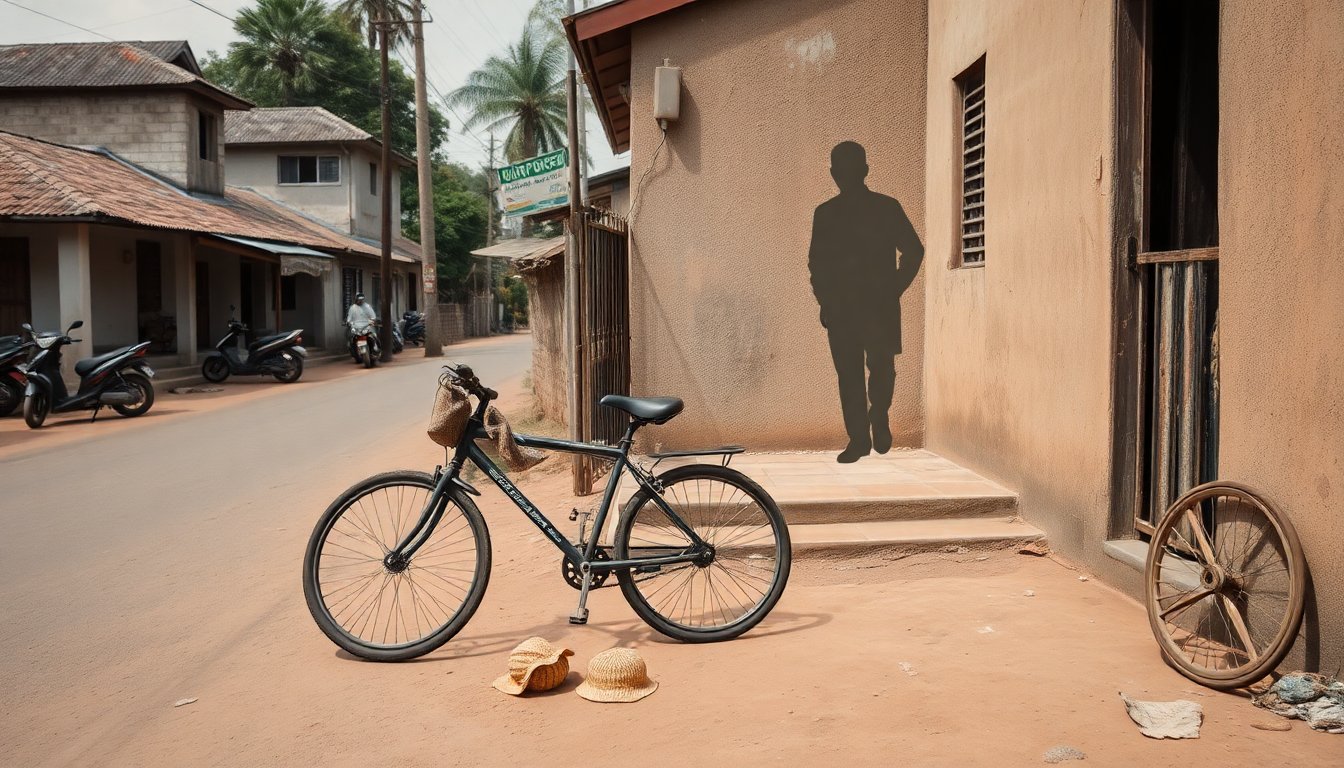
My Father’s Shadow is the debut feature from British Nigerian director Akinola Davies Jr., a film that foregrounds an intimate family relationship while the nation around the characters trembles. Told largely from the viewpoint of two young brothers, the movie walks the line between a coming-of-age family drama and a portrait of civic unrest tied to the disputed 1993 Nigerian presidential election. The film screened at the 2026 BFI London Film Festival and will be released by MUBI on February 6, 2026, with a wider theatrical opening on February 13.
The story follows brothers Akin and Remi, played by real-life siblings Godwin Chiemerie and Chibuike Marvellous Egbo, who are taken by their father Fola (Ṣọpẹ́ Dìrísù) on a trip from their rural village to Lagos. What begins as a simple excursion become a layered education in adulthood: the boys learn about their father’s past, his sacrifices, and the wider political anxiety of a country awaiting election results. Davies Jr.’s work emphasizes visual details and small gestures, asking the audience to observe the world as children do—curious, distracted, and impressionable.
The central relationship: fatherhood, absence and small revelations
At the heart of the film is the dynamic between Fola and his sons. He is an often-absent parent trying to make up for lost time, and Ṣọpẹ́ Dìrísù delivers a performance that communicates both quiet vulnerability and restrained urgency. The movie spends a lot of its runtime excavating this emotional territory: scenes where Fola shares stories about how he met their mother or recounts a painful family memory become the emotional backbone of the film. These exchanges are staged with care, and they allow the boys to gradually recognize that their parents had full lives before they were born—an awakening that functions as a classic coming-of-age pivot.
The material shines when it stays focused on those domestic, character-driven moments. The familial revelations are deliberately modest: none require an awareness of the political stakes to land emotionally. That quiet intimacy is the film’s most effective device, as the audience witnesses children forming new impressions of an adult who is both protector and flawed, generous but secretive.
Politics as background pressure: when public conflict becomes private lesson
Davies Jr. ties the family story to the country’s political turmoil, notably the annulled 1993 election and the atmosphere of protest and repression that followed. The film depicts this social unrest through incidental details—newspaper headlines, armed convoys, and anxious conversations—rather than expository lectures. At times the movie chooses to spell out context more directly, which can feel at odds with the decision to maintain a child’s focalization. Those explanatory moments occasionally pull the audience away from the subtle point of view the film otherwise sustains.
Yet the political thread remains integral because it refracts the father’s behavior: Fola’s activism, his financial struggles, and his careful choices are all shaped by an environment in which dissent is dangerous and survival is precarious. The story doesn’t require viewers to grasp every historical nuance; instead, it uses the national crisis as a pressure valve that reveals character. When protesters appear on beaches or public spaces empty of other children, the film lets the imagery do the work, creating an ominous backdrop that never overwhelms the personal story.
Portrayal and pacing
The film’s pacing leans toward quiet observation rather than dramatic escalation. Many sequences unfold across a single day, giving the film a compressed, memory-like quality that helps sell its autobiographical register. The long, patient takes and the attention to small, sensory details—crowds, vendor stalls, the tilt of a bus seat—establish a lived-in world. This approach rewards viewers willing to stay present for subtle emotional shifts. However, the same restraint can feel like caution: at moments the director seems unwilling to assume the audience’s ability to infer context, resulting in intermittent exposition that softens the film’s otherwise confident tone.
Performances and direction
Ṣọpẹ́ Dìrísù anchors the film with a layered turn, while the two young leads bring authentic chemistry and spontaneity to their roles. Davies Jr.’s direction demonstrates a firm sense of atmosphere and visual composition, even if the storytelling occasionally hedges. As a first feature, the film suggests a filmmaker discovering his voice, one who knows how to stage intimate scenes and capture childhood wonder but who may still be calibrating how much to trust the audience.
My Father’s Shadow is a warm, observant movie about the small revelations that make children grow into adults. Its best moments are the unadorned ones: a father recounting private history, siblings learning to see him fully, a cityscape that feels both inviting and threatening. The film’s political dimension enriches the narrative, even if intermittent context-setting undermines the child’s vantage point the director largely preserves.
Note: screened at the 2026 BFI London Film Festival; released by MUBI on February 6, 2026; opens in theaters on February 13.