
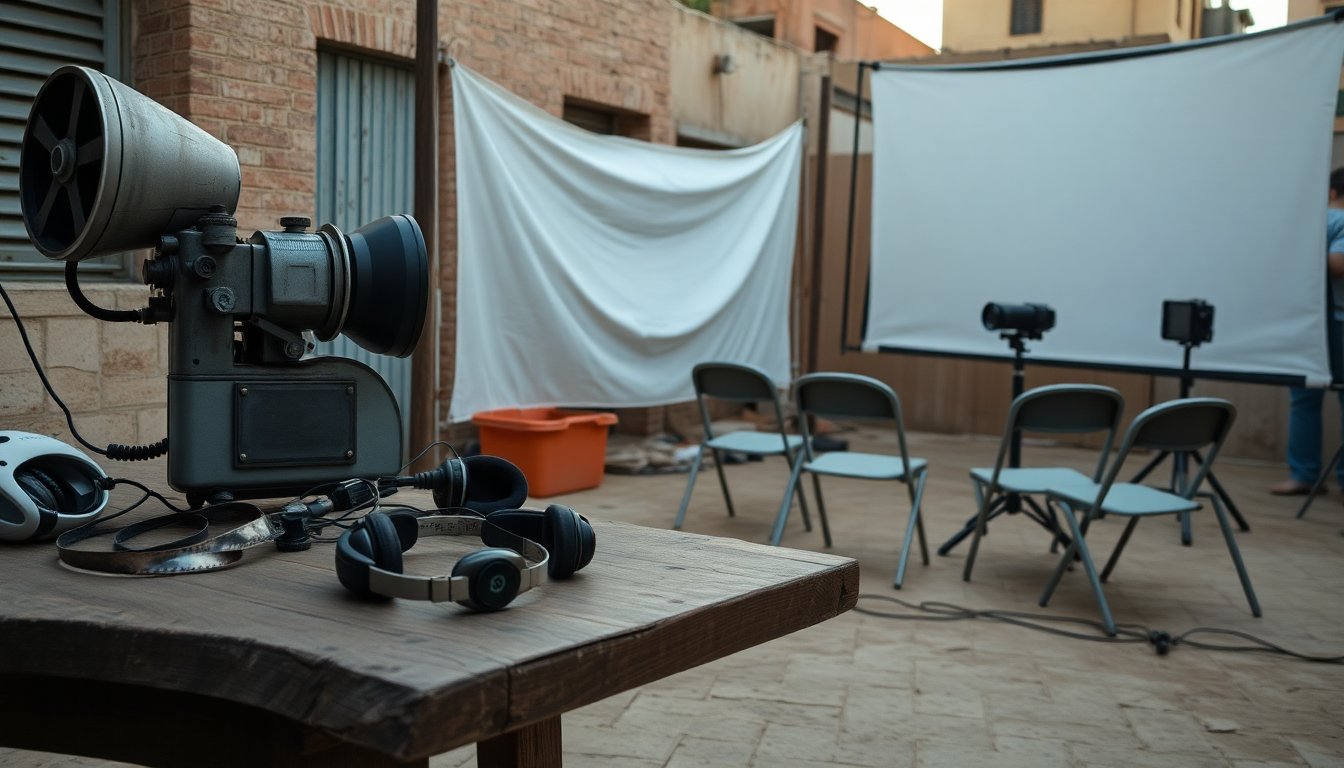
The North African festival circuit and the wider film industry are in motion: Tunisian artist Afef Ben Mahmoud has been named director of the eighth Gabès Cinema Festival, a biennial event that merges cinema, video art and immersive practice with local civic concerns. At the same time, the Doha Film Institute announced high-profile mentors for its Qumra incubator, and industry observers continue to debate how African cinema can convert growing creative recognition into sustainable market access.
These developments illuminate two interlocking trends: grassroots festival initiatives that foreground place-based issues and cross-disciplinary practice, and pan-regional efforts—both institutional and commercial—to shepherd filmmakers from script to global audience. Together they reveal the complex landscape that contemporary Arab and African filmmakers must navigate.
Gabès cinema festival: local focus, interdisciplinary program
Founded in 2019, Gabès Cinéma Fen was designed as more than a film showcase: it is a platform for dialogue between artists and the city. The festival uses screenings, installations and workshops to interrogate the environmental and social realities of Gabès, a Mediterranean port in southern Tunisia affected by industrial pollution linked to a phosphate fertilizer plant. The appointment of Afef Ben Mahmoud—an actor-turned-director with a cross-disciplinary practice—signals a continued commitment to experimental curation and civic engagement.
Ben Mahmoud’s artistic résumé links acting and directing. International audiences may recognize her from Nouri Bouzid’s drama The Scarecrows, Mehdi Hmili’s Streams, and more recently Mohamed Ali Nahdi’s boxing drama Round 13. She debuted as a director with the ensemble film Backstage (), co-directed with Khalil Benkirane; that project screened in Venice’s Giornate degli Autori sidebar. Ben Mahmoud told festival organizers that Gabès resonates with her practice because the event privileges a dialogic, cross-disciplinary view of creation: programming that treats artistic work as a way to reflect on social and ecological contexts.
Qumra masters: mentorship and cross-border conversation
The Doha Film Institute reinforced its role as a development hub by inviting an international roster of industry figures to its Qumra program. The upcoming edition’s Qumra Masters includes multifaceted filmmakers such as Gael García Bernal and Diego Luna, Venice prizewinner Alice Diop, Moroccan auteur Faouzi Bensaïdi, and composer-producer Gustavo Santaolalla. Qumra combines a creative workshop, a co-production market and curated screenings intended to support early-career directors and to foster networking between Arab and global cinema professionals.
DFI leadership framed the lineup as evidence that generous mentorship can reshape creative trajectories. Qumra—now in its 12th edition—serves as both an artistic incubator and an industry meeting point, bringing projects at various stages to Doha for guided development and exposure. The event is scheduled to run from March 27 to April 1, offering sessions that mix onstage conversations with bespoke mentorship.
Mentors with multiple industry hats
Observers have highlighted the value of inviting practitioners who operate across roles—actors who direct and produce, for example—because they can advise on the multiple demands of contemporary film careers. Qumra’s combination of artistic insight and practical guidance mirrors a wider push to equip filmmakers with tools for financing, production and strategic positioning.
African cinema: creative momentum and market realignment
African filmmakers are finding prominent platforms at major festivals, even as the commercial market undergoes a period of contraction and reconfiguration. The Berlinale lineup exemplifies this creative momentum: filmmakers such as Mahamat-Saleh Haroun and Alain Gomis are competing at the highest level, while first features from talents like Olive Nwosu and Sandulela Asanda are also gaining international premieres. These programming wins underscore the increasing visibility and critical esteem of films from across the continent.
At the same time, consolidation and strategic reappraisals among global streaming and broadcast players have reduced some distribution avenues that had opened in recent years. Major acquisitions and subsequent cost-control measures have created uncertainty about future commissioning and acquisition windows. In response, African industry leaders and financiers are pursuing a plurality of solutions: from large-scale funds such as the Africa Film Fund to private initiatives like Next Narrative Africa’s multi-million-dollar commitments, and localized experiments in distribution and creator-driven platforms.
New funding models and local resilience
Industry executives note a necessary shift away from over-reliance on foreign platforms. The contraction of some global buyers has catalyzed conversations about building indigenous revenue streams, strengthening theatrical exhibition where possible, and investing across the production chain—from studios to post-production and distribution. Successes at festivals and targeted investments suggest that, with the right infrastructure, African storytelling can continue to expand its global reach while cultivating sustainable local markets.
Taken together, the appointment of Afef Ben Mahmoud in Gabès, Doha’s continued investment in mentorship through Qumra, and the African industry’s pragmatic response to market shifts paint a picture of a creative ecosystem adapting to new realities: one that prizes local context, cross-disciplinary exchange and strategic rebuilding of distribution pathways.