
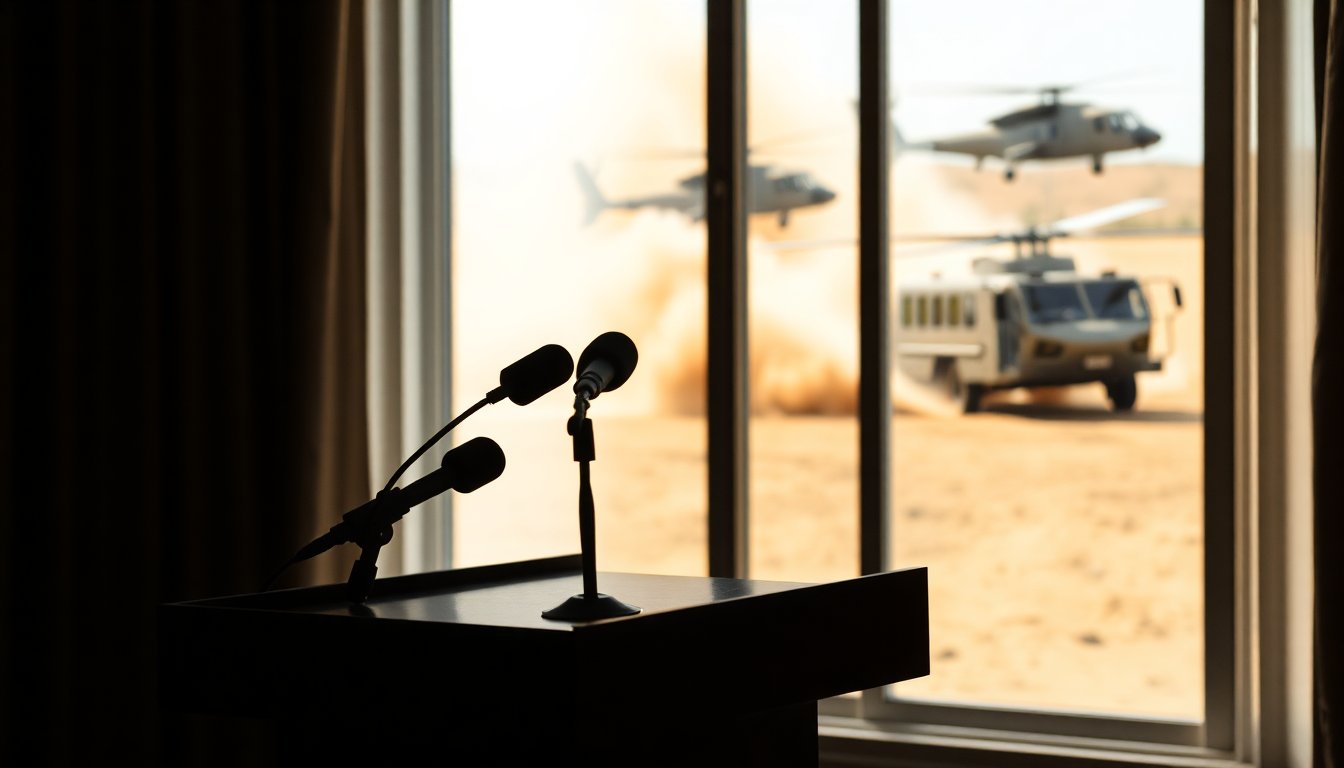
The late-night show segment opened by homing in on a striking piece of presidential rhetoric: an insistence on avoiding the word war in favor of the phrase “military operation”. The host highlighted how word choice shaped public perception even as events on the ground told a different story. Through sharp humor, the segment questioned whether terminology was being employed to sidestep constitutional or political consequences tied to declaring a war, and it contrasted that linguistic sleight of hand with the tangible human and strategic costs unfolding in the Middle East.
At the same time, reporting from multiple outlets traced a widening cascade of consequences—casualties on both sides, threats to global trade routes, and strains inside the U.S. government and Congress. The piece wove together satire and sober reporting to show that whether a leader labels an action a war or a military operation, the effects—diplomatic pushback, economic disruption, and mounting deaths—remain concrete and consequential.
Television satire meets real-world violence
In the televised critique, the comedian lampooned the administration’s circumspect vocabulary while cataloguing recent developments: public threats to disable Iran’s power grid, social media posts promising prioritization of certain targets, and a reported consideration of sending another 10,000 troops to the region to expand U.S. options. Those public statements were juxtaposed with data points cited by journalists and officials: an estimated 2,000 Iranians killed and 13 U.S. service members among the fatalities so far. The segment underscored the dissonance between framing a campaign as a carefully limited operation and the daily reality of strikes, retaliations and deepening entanglement.
Regional fallout and global consequences
Beyond the immediate battlefield, the conflict has had ripple effects across the region and the world. Authorities in the United Arab Emirates reported two civilians killed and several injured when debris fell after an intercepted ballistic missile, illustrating how interceptions can still cause ground casualties. Israel reported identifying missiles launched toward its territory, and the United Arab Emirates said its air defenses were responding to incoming threats. Meanwhile, an international voice warned of broader economic effects: the closure of the Strait of Hormuz has interfered with shipments of oil, gas and fertilizer, prompting concerns about food production and energy security in import-dependent countries.
Economic and humanitarian tensions
Leaders outside the conflict zone have signaled alarm. A senior European defense official labeled the confrontation a potential catastrophe for world economies, pointing to early indicators of market and supply-chain stress. The United Nations secretary-general publicly framed the shipping disruptions as a threat to the global planting season, noting that one-third of seaborne fertilizer trade moves through the Strait of Hormuz. Nations in Asia reacted by activating contingency funds and seeking extra fuel supplies to stabilize domestic markets, emphasizing that far-flung consumers already feel the consequences of a region in conflict.
U.S. political and military debate
At home, congressional briefings grew tense as lawmakers pressed for clarity about strategy and goals. Members of the House Armed Services Committee and other officials expressed frustration at what they described as a lack of a clear endgame or fully articulated plan. Some lawmakers warned that the deployment of ground troops to Iran would constitute a red line that could alter their support. One congresswoman publicly declared opposition to boots on the ground after a closed-door briefing, underscoring the political fragility around escalation decisions.
Military claims and resignations
Military leaders publicly described a high tempo of strikes and flights, with Central Command releasing assessments of extensive targeting inside Iran and asserting significant damage to naval and weapons infrastructure. Those operational claims exist alongside internal dissent: a senior counterterrorism official resigned and wrote that Iran did not pose an imminent threat, signaling fractures within the administration’s national security ranks. Such departures and competing narratives have amplified questions about the war’s justification and strategic coherence.
What the language debate reveals
The comedic takedown served a broader purpose: to expose how semantics can be used to manage legal, political and public reactions even while violence escalates. Whether described as a military operation or a war, the conflict has produced casualties, economic dislocation and diplomatic pushback. The nightly satire, congressional unease and international warnings together sketch a picture of a crisis where words matter—but so do actions, losses and the absence of a clear pathway to a sustainable resolution.