
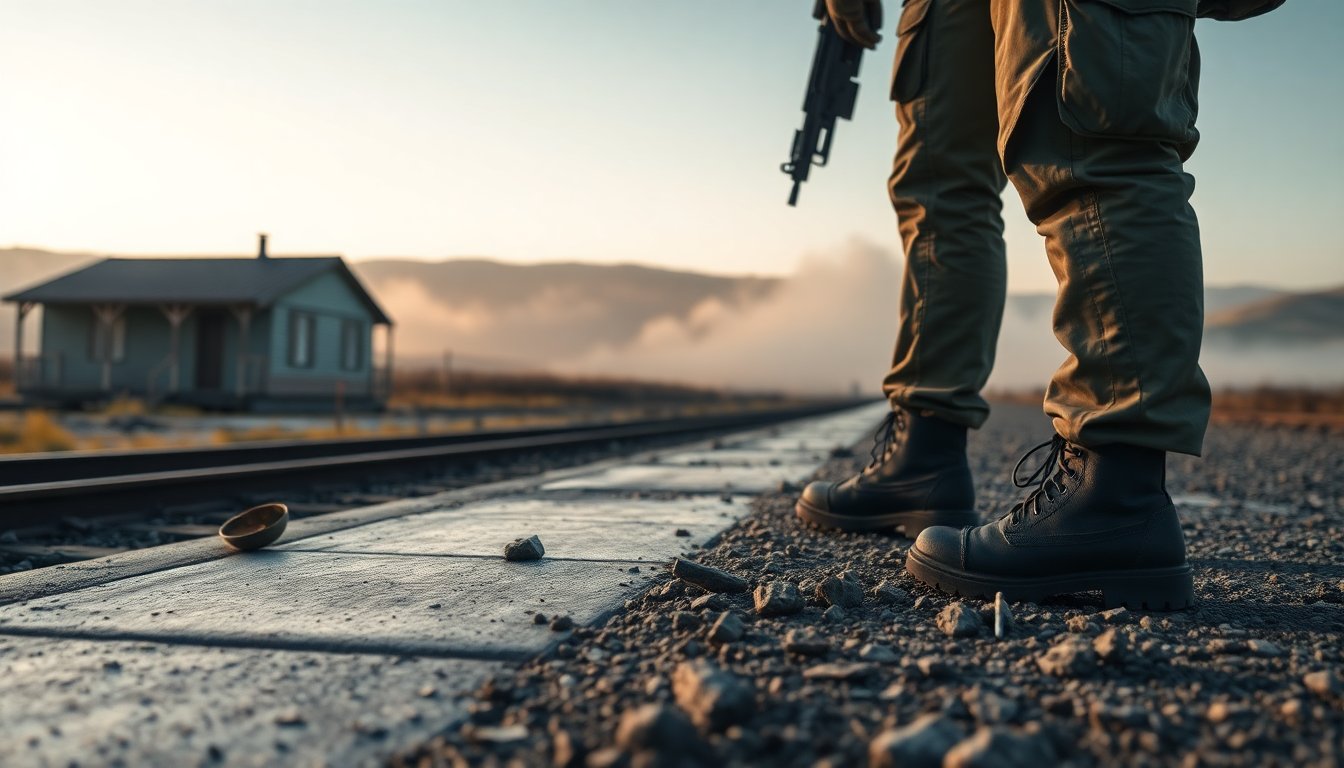
Marshals drops Luke Grimes’ Kayce Dutton and his team into a chilling set piece in episode two: a violent takedown staged in the so-called “Zone of Death.” Fans of Yellowstone will recognize the terrain—this is the same remote killing ground the Duttons once called the Train Station—recast here as a place where jurisdictional quirks invite impunity.
The scene is shorthand: isolation plus legal fog equals danger. That dramatic shorthand works precisely because the Zone of Death isn’t pure invention. It springs from a real, odd wrinkle in federal jurisdiction over Yellowstone National Park—an anomaly that legal scholars have been turning over for years and that TV writers have found irresistible.
Where the law and the map fail to line up
Yellowstone isn’t contained in a single state. It spills across Wyoming, Montana and a tiny corner of Idaho. Congress, however, assigned the whole park to the federal District of Wyoming. That administrative choice has a quirking consequence under the Sixth Amendment. The Constitution guarantees a defendant the right to a jury drawn from “the State and district wherein the crime shall have been committed.” In practice, that becomes a problem in the Idaho sliver of Yellowstone: a jury would need jurors who are both residents of Idaho and residents of the Wyoming federal judicial district. Put differently, jurors would have to live in an area that, for all practical purposes, is almost unpopulated.
Michigan State law professor Brian C. Kalt crystallized this theory in a widely read article. His point wasn’t sensationalism so much as logic: if no eligible jurors live in that Idaho enclave, then convening a constitutional jury in the assigned district might be impossible. That theoretical gap—small on the map but large in consequence—earned the nickname the “Zone of Death,” and it has since become a convenient device for storytellers and a provocative question for constitutional scholars.
Why the jury question matters
At its core this is about the Sixth Amendment’s protections. If the venue and jury-selection rules cannot be met, a defendant could argue that a trial would violate the right to an impartial jury from the proper community. Legal commentators warn this isn’t a mere technicality: a successful challenge could block a federal prosecution for serious crimes in that Idaho parcel unless courts or Congress act.
In practice, the area’s near-zero year-round population makes the problem more theoretical than quotidian. Federal prosecutors have not reported widespread use of this so-called loophole to escape justice. Still, the prospect matters because it tests how rigidly courts will apply the text of the Constitution against the realities of geography and administration.
How the law can respond
There are several paths to close—or at least blunt—the gap. Congress could redraw judicial boundaries or explicitly change venue assignments for the park. Courts might interpret venue and jury-selection rules in ways that avoid constitutional conflict, using doctrines that allow venue transfers when a fair jury can’t realistically be assembled. Prosecutors have tools too: charging related offenses that don’t hinge on the same residency question, coordinating with neighboring districts, or invoking grand juries and interstate task forces.
None of these solutions is automatic. Legislative changes raise their own constitutional questions; judicial workarounds depend on judges’ willingness to adopt broader readings of the Sixth Amendment’s residency language. The most likely route to resolution is incremental—either through test cases slowly wending their way up the courts or through a targeted congressional fix.
What’s been tested so far
There have been flirtations with the theory in court, but no definitive high-court ruling. One notable episode involved Michael Belderrain, who pleaded guilty in 2005 to elk poaching in Yellowstone’s Montana section after his legal team raised the Idaho-jury theory. The argument didn’t carry the day in district court, and because the case ended with a plea, the constitutional question never reached an appellate court for a binding resolution.
Congress has batted around corrective ideas, including reassigning the Idaho parcel to another judicial district, but no statute has changed the status quo. That leaves the issue suspended between theoretical concern and practical improbability—ripe for dramatization, less ripe for immediate courtroom chaos.
The scene is shorthand: isolation plus legal fog equals danger. That dramatic shorthand works precisely because the Zone of Death isn’t pure invention. It springs from a real, odd wrinkle in federal jurisdiction over Yellowstone National Park—an anomaly that legal scholars have been turning over for years and that TV writers have found irresistible.0
The scene is shorthand: isolation plus legal fog equals danger. That dramatic shorthand works precisely because the Zone of Death isn’t pure invention. It springs from a real, odd wrinkle in federal jurisdiction over Yellowstone National Park—an anomaly that legal scholars have been turning over for years and that TV writers have found irresistible.1
The scene is shorthand: isolation plus legal fog equals danger. That dramatic shorthand works precisely because the Zone of Death isn’t pure invention. It springs from a real, odd wrinkle in federal jurisdiction over Yellowstone National Park—an anomaly that legal scholars have been turning over for years and that TV writers have found irresistible.2
The scene is shorthand: isolation plus legal fog equals danger. That dramatic shorthand works precisely because the Zone of Death isn’t pure invention. It springs from a real, odd wrinkle in federal jurisdiction over Yellowstone National Park—an anomaly that legal scholars have been turning over for years and that TV writers have found irresistible.3