
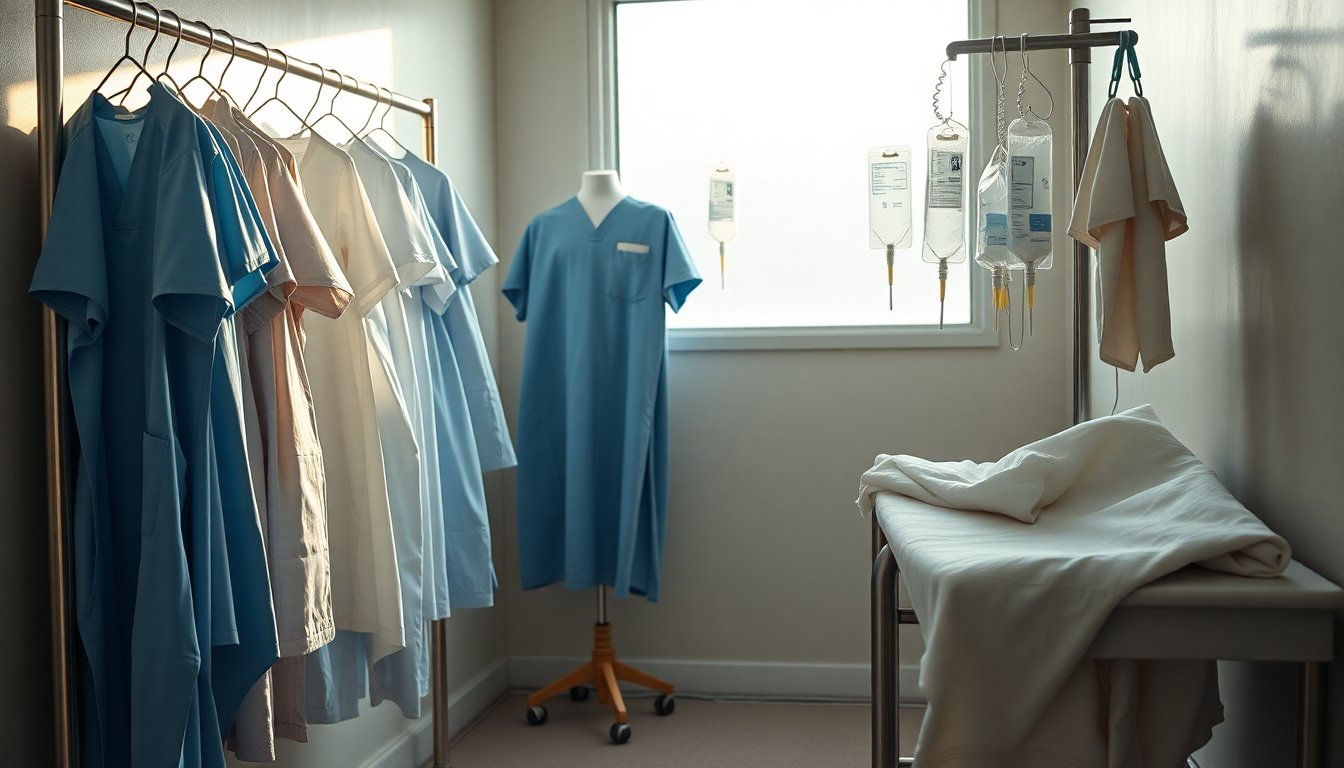
The television series The Pitt deliberately confines each season to a single, continuous hospital shift, a creative decision that informs every production detail. By filming the day in sequence — beginning with the first page of the first episode and largely moving forward in order — the show aims to preserve a palpable sense of temporal flow. That strategy demands obsessive continuity, coordination across departments and an unusual approach to aging sets, costumes and medical gear so the viewers always believe they are inside a single uninterrupted 15-hour stretch.
Behind that apparent simplicity is a large, interconnected operation. Production designer Nina Ruscio and costume designer Lyn Paolo emphasize that the continuity becomes an engine for performance: small, cumulative changes inform the actors’ choices and keep the medical center’s environment evolving visibly but naturally. The creative result depends on careful lists, diagrams and a culture that treats tiny details as significant.
Designing a hospital that changes in front of the camera
Ruscio created layered diagrams and maps of the Pittsburgh Trauma Medical Center so the art, props and set teams could track movement, placement and the physical history of every element. The production records where each gurney travels, which machines are wheeled into which bay and which whiteboard entry was erased. This is not mere neatness: once an object is removed from a drawer or a machine is relocated, that absence must persist on-screen. The team insists that the set behave like a real workplace — if equipment is used, it doesn’t magically reappear minutes later.
Prop choreography and 360-degree realism
That level of authenticity means departments collaborate on what Ruscio calls prop choreography: a prop might need input from the prop master, the set-decoration crew, the actor and video technicians. Every position is charted so continuity errors don’t disrupt the immersive world. The approach allows the camera to roam with confidence; when viewers can inspect a room in 360 degrees, nothing should betray the illusion. The production treats every visible object as a storyteller in its own right.
Costumes, crowd tracking and the logistics of wear
The costume department faces an industrial-scale tracking challenge. Paolo and her team catalog between 300 and 400 people per season — including dozens of background actors who might be on gurneys or in waiting rooms for the entire shoot. For each person, the team maintains inventories of multiples: scrubs, personal clothing, belts, shoes and even underwear. Nothing an actor wears is assumed to be theirs; every article is logged, aged and rotated to reflect the passage of time during a long, grueling shift.
Aging garments and the tyranny of detail
Costume aging is a granular art. The crew fabricates several copies of the same item so they can show subtle deterioration as the shift progresses: a blood-stained T-shirt becomes dirtier, scrubs accumulate wear, and a pin on a nurse’s lapel moves from pristine to battered. Paolo recalls sourcing a vintage Liberty Bell pin for Charge Nurse Dana Evans — then commissioning replicas so the pin could undergo incremental wear without breaking continuity. The goal is that viewers shouldn’t notice the craft; they should only feel the day’s weight on the characters.
Story structure, fans and the limits of a single-shift format
The show’s storytelling constraint — each season compressed into a single shift — also shapes audience reactions. Because relationships and plotlines are confined to a tight real-time arc, some character beats are impossible to stretch into long-term arcs. Producer and star Noah Wyle has explained that a teaching hospital naturally includes turnover: people come and go, sometimes abruptly. That realism can frustrate fans who want more closure or longer redemption arcs for certain characters.
Social media has turned a portion of the fanbase into intense critics, especially when cast changes happen. The departures of actors such as Tracy Ifeachor after Season 1 and the announced absence of Supriya Ganesh beyond Season 2 have spurred speculation, rumors and conspiracy theories. Some viewers react as if television choices must align with their expectations; the show’s compact, in-the-moment format resists that model. Comparisons to other serials — which may resolve conflicts quickly or engineer tidy transformations — illuminate why The Pitt’s uncompromising pace can be both its strength and a source of frustration.
Season 2 changes and what viewers can expect
For Season 2 the team expanded the physical footprint to allow more triage action without breaking continuity. Ruscio added a set extension intended to feel like it had always been part of the hospital — a success if no one notices. Production rumors and reporting also signaled personnel shifts: the season confirms a new acting lead will take the reins at PTMC (it is not Dr. Al-Hashimi), and the character Robby is set to step away on what is presented as a sabbatical. The series is available on HBO Max, and the Season 2 finale is scheduled to air on April 16.
Ultimately, The Pitt’s design philosophy is simple and exacting: every visible choice should support the single-shift premise. When costumes, props and choreography align, the series achieves a rare kind of realism, where the production’s labor is invisible and only the human drama remains in plain view.