
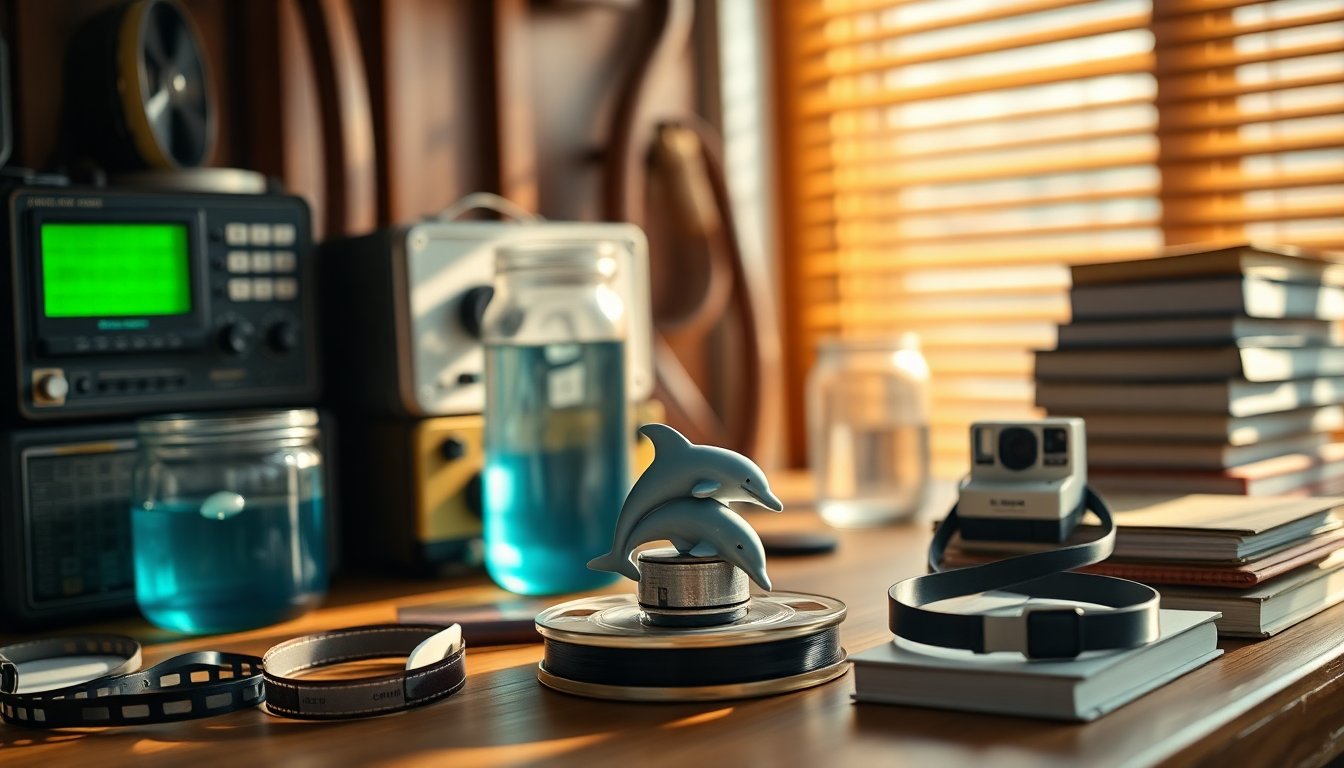
The documentary John Lilly and the Earth Coincidence Control Office reopens a provocative chapter in twentieth-century science and culture, inviting viewers to reconsider how often we actually think about dolphins. Co-directed by Michael Almereyda and Courtney Stephens, the film layers archival footage, interviews, and a guiding voiceover by Chloë Sevigny to map a life that blurred lab bench and counterculture. This introduction frames the central inquiry without yielding easy judgments: it treats Lilly as a complex figure whose methods and ideas remain compelling, contentious, and cinematic in equal measure. The film is designed to feel dense and immersive, matching the strange terrain of its subject.
At the center of the story is Dr. John C. Lilly, a researcher whose experiments ranged from dolphin communication studies to experiments with psychedelics and sensory deprivation. His personal motto, often quoted in the film, was “my body is my laboratory”, a phrase that captures both scientific curiosity and radical self-experimentation. The documentary traces how Lilly’s work seeped into broader culture and inspired cinematic imagination, including references to projects like Ken Russell’s Altered States and Mike Nichols’s The Day of the Dolphin. Throughout, the filmmakers resist hagiography, instead presenting a portrait that highlights his ingenuity alongside his more controversial choices.
A portrait of an experimental life
This section situates Lilly’s pursuits within a broader history of postwar research and cultural experimentation. The film emphasizes Lilly’s efforts to study interspecies communication and the biological basis of consciousness, using both lab technologies and radical personal techniques. Viewers are shown his work with cetaceans framed as part science project and part philosophical quest, with the documentary often pausing to let archival moments speak. By foregrounding archival evidence and interviews, the filmmakers construct a narrative that treats Lilly’s contributions to cognitive science and his cult status with equal seriousness. The result is an investigative portrait that illuminates how one mind could bridge laboratory procedure and metaphysical speculation.
The directors’ approach
Michael Almereyda’s sensibility
Michael Almereyda brings to the project a background in fiction filmmaking and artist portraits, making him adept at blending stylistic play with documentary rigor. Known for features like the recently restored Nadja and a string of portraits of creative figures, Almereyda contributes a cinematic eye that respects texture and rhythm. In this film, his instincts for composition and tonal control shape sequences that move between the clinical and the uncanny, highlighting how scientific imagery can acquire mythic dimensions. His contribution helps the film avoid linear biography, favoring instead a collage-like approach that mirrors the experimental nature of Lilly’s life.
Courtney Stephens’ documentary expertise
Courtney Stephens complements Almereyda with a deep practice in non-fiction and hybrid forms; her previous work includes Terra Femme and the collaborative The American Sector, while her hybrid film Invention premiered at Locarno in 2026 and received a Pardo for Best Performance. Stephens’ background—exhibitions at institutions such as MoMA, the National Gallery of Art, and the Barbican, along with festival screenings at Berlinale, IDFA, SXSW, and others—shapes a methodology that privileges archival reclamation and formal inventiveness. Her curatorial and scholarly interests inform the film’s pacing and its attention to the cultural afterlives of scientific ideas.
Screenings, soundtrack and practical details
The film began its theatrical rollout with support from Oscilloscope and is presented in a crisp DCP format, running 89 minutes and recommended for audiences 16 and older. A notable creative choice is the narration by Chloë Sevigny, whose voice provides connective tissue between images and testimony, while the soundtrack—featuring a hypnotic piece by Lex Walton—reinforces the film’s immersive mood. For those interested in public screenings, the film is listed for a presentation at Speed Cinema on Sunday, April 12, with ticket prices set at $12 and $8 for Speed members, a useful stop for viewers wanting to experience the film in a communal setting.
Ultimately, John Lilly and the Earth Coincidence Control Office functions as both cultural archaeology and cinematic meditation: it excavates archival material, maps influence on popular imaginings of consciousness, and asks audiences to consider the ethical and aesthetic dimensions of radical inquiry. Whether you encounter the film in a festival setting or a neighborhood theater, it offers a layered encounter with an individual who pushed scientific boundaries and inspired a generation of artists and thinkers. The film’s blend of archival richness, directorial craft, and sonic atmosphere makes it essential viewing for anyone interested in the intersection of science, culture, and experimentation.