LAIKA Animation Studios released Wildwood on October 23, 2026, delivering a 2-hour-12-minute fantasy that doubles as a love letter to Portland, Oregon. The picture adapts Colin Meloy’s 2011 novel, illustrated by Carson Ellis, and marks the studio’s longest stop-motion effort to date. While many studios have shifted to fully computer-generated imagery, LAIKA chose to reaffirm the tactile charm of puppetry, pushing the format beyond any previous benchmark.
The narrative follows twelve-year-old Prue McKeel, voiced by Peyton Elizabeth Lee, as she chases a flock of crows that have abducted her infant brother, Mac. Along the way she teams with classmate Curtis (Jacob Tremblay), confronts the sinister Dowager Governess Alexandra (Carey Mulligan), and encounters a motley cast that includes Mahershala Ali as the Bandit King and Richard E. Grant as Owl Rex. The plot unfolds in the so-called Impassable Wilderness, a magical forest that refuses entry to ordinary humans, turning Portland’s familiar streets into a gateway to a surreal realm.
Portland’s streets become a stop-motion set
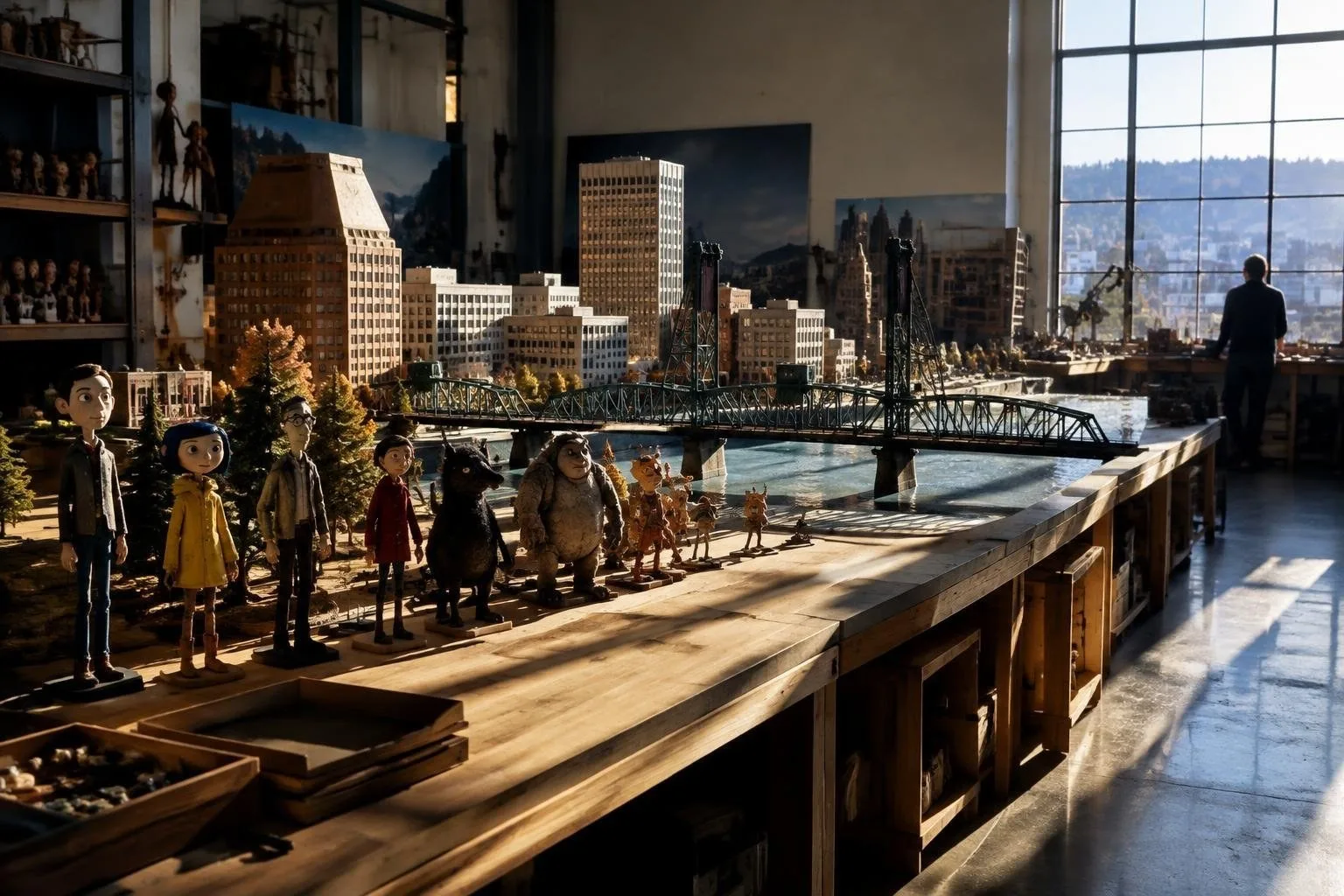
Production designers reconstructed iconic locations such as Powell’s City of Books, the St. Johns Bridge, Voodoo Doughnuts, and the ubiquitous Benson Bubblers as oversized, hand-built sets that rise up to fifteen feet tall. Director of rapid prototype Brian McLean explains that each miniature captures the city’s visual language while being stylized for the film’s internal logic. “These aren’t exact replicas, but they sit within the world we built,” he says. The attention to detail extends to the signage above Powell’s, the rivets on the bridge, and the gleam of the drinking fountains, all rendered in a palette that feels simultaneously realistic and fairy-tale.
Crafting the animation: replacement faces and 3D printing
LAIKA employed its signature replacement animation method, swapping out individual facial components for each frame to achieve fluid expression. Over the past decade the studio refined this technique with rapid 3D printing, a process that earned an Academy Scientific and Engineering Award in 2016. For Wildwood the art department printed roughly 142,000 interchangeable faces, giving 49 animators the ability to generate up to three seconds of footage per week. At a standard 24 frames per second, that translates to a staggering 2,700 distinct shots across 132 physical sets. Mechanical puppets featuring breathing rigs and flexing muscles added an extra layer of realism, while cinematographer Caleb Deschanel treated the miniature world as a live environment, capturing natural light, weather, and depth.
Box office, runtime, and the film’s place in LAIKA’s catalog
With a running time of 132 minutes, Wildwood is not only the longest stop-motion feature ever released but also the studio’s most ambitious commercial venture. Domestic earnings have reached approximately $32 million as of the first weekend, a solid figure for a non-CGI family film. The project represents 16 years of development under CEO Travis Knight, who also directed the picture. Alongside earlier successes like Coraline, ParaNorman, and Kubo and the Two Strings, Wildwood demonstrates LAIKA’s willingness to invest in large-scale, labor-intensive storytelling at a time when many competitors favor cheaper digital pipelines.