
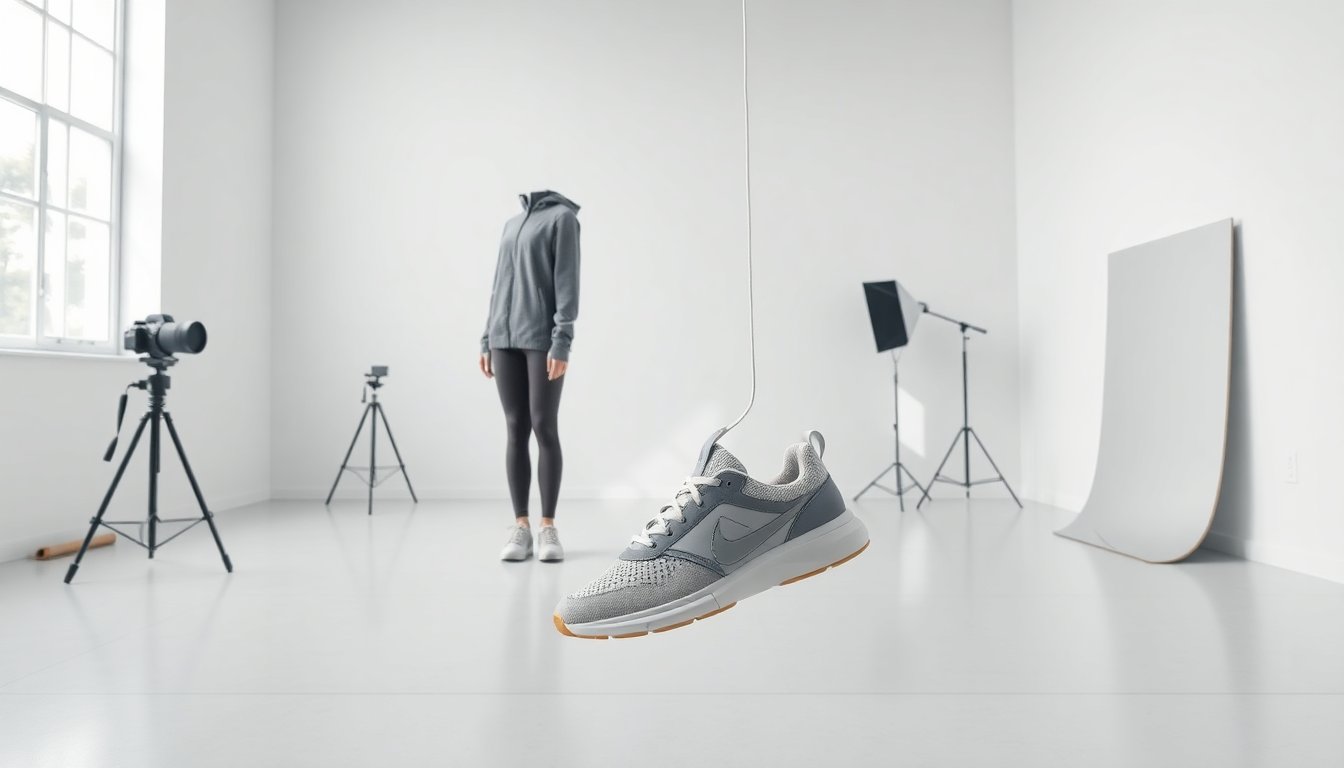
The latest short by Spike Jonze collapses the line between advertisement and art. Clocking in at roughly three minutes, Shape of Dreams showcases Zendaya in a minimalist, almost clinical setting while the camera and props reshape the space around her. Rather than a straightforward product reel, the piece reads as a condensed exercise in imaginative staging—one where surrealist motifs meet the mechanics of campaign storytelling.
Behind the scenes, this film is part of a larger collaboration between Zendaya, her stylist Law Roach, and Swiss brand On, which expands the brand’s move into lifestyle and personality-driven design. The short functions as both an introduction to a co-designed footwear and apparel line and a standalone exploration of how movement, material and idea converge when a filmmaker known for inventive visuals applies his voice to a commercial brief.
The creative concept and narrative frame
At its core, Shape of Dreams uses the white studio as a blank stage where imagination is given physical form. The film stages a series of encounters between Zendaya and oversized, shifting objects that feel at once playful and uncanny. These interventions act as visual metaphors for the iterative process of design: ideas are sketched, stretched and assembled in front of the viewer. The short names this imagined environment the Dream Lab, which functions less like a literal workspace and more like a cinematic mind map where garments and gestures are shaped into finished pieces.
Structurally, the film resists a conventional story arc in favor of associative moments. Rather than linear problem-and-solution beats, we watch a progression from stillness to kinetic energy—an evolution that mirrors product development and performance. This framing lets the campaign present clothes as instruments of motion, not merely as static fashion objects, while giving Zendaya room to embody the collection’s intent.
Visual language and technical approach
Practical effects, scale and choreography
One of the most striking devices is the manipulation of scale: giant hands, oversized tools and dramatically disproportionate props enter the frame to adjust posture or alter garments. These moments provide a tactile sense of creation and distance the film from glossy, purely digital advertising. Spike Jonze favors practical effects and tangible transitions—panels carried by performers, mirrors shifted into place—so that scene changes feel physically enacted rather than composited. Movement is choreographed in a way that sits between dance and athletic training, reinforcing the dual identity of the collection as both stylish and functional.
Sound design and rhythm as narrative engines
The short’s editing is tightly coupled to an evolving soundscape. Percussive, fragmented beats begin the piece and gradually give way to a fuller, driving rhythm that mirrors the visual intensification. This audio progression helps sell the idea that the collection is built around motion: the score and effects dictate pacing, cuts and the emotional arc. In that sense, sound design becomes a primary storytelling tool, propelling the viewer through the designer’s decision-making process as surely as any visual cue.
Context: collaboration and brand strategy
This project continues a multi-year relationship between Zendaya and On; the brand has worked with her since 2026 and previously released collaborative drops like the Cloudzone Moon shoe. The current film sits alongside still photography by Sean Thomas, which documents the more literal behind-the-scenes moments. Together, moving image and stills create a layered launch package that highlights creative collaboration—from stylist guidance to product engineering—while centering the celebrity’s voice in the brand’s lifestyle positioning.
For Spike Jonze, who has spent the years since his last narrative feature working across music videos, specials and branded content, this short is another demonstration of how cinematic language can elevate a commercial brief. It’s a reminder that advertisements can be experimental spaces: by embracing surrealist elements and prioritizing practical invention, a three-minute film can feel like a miniature statement rather than a simple sales tool.
Why this piece matters
Beyond product promotion, Shape of Dreams operates as a compact case study in creative partnership. It shows how a director with a strong personal aesthetic can translate brand objectives into evocative imagery without sacrificing complexity. The result is a campaign that will likely be shared and discussed for its visual ingenuity, and which underscores how contemporary marketing often seeks cultural resonance as much as conversion. In short, the short proves that when filmmakers and brands align, the outcome can be both commercially effective and artistically spirited.