
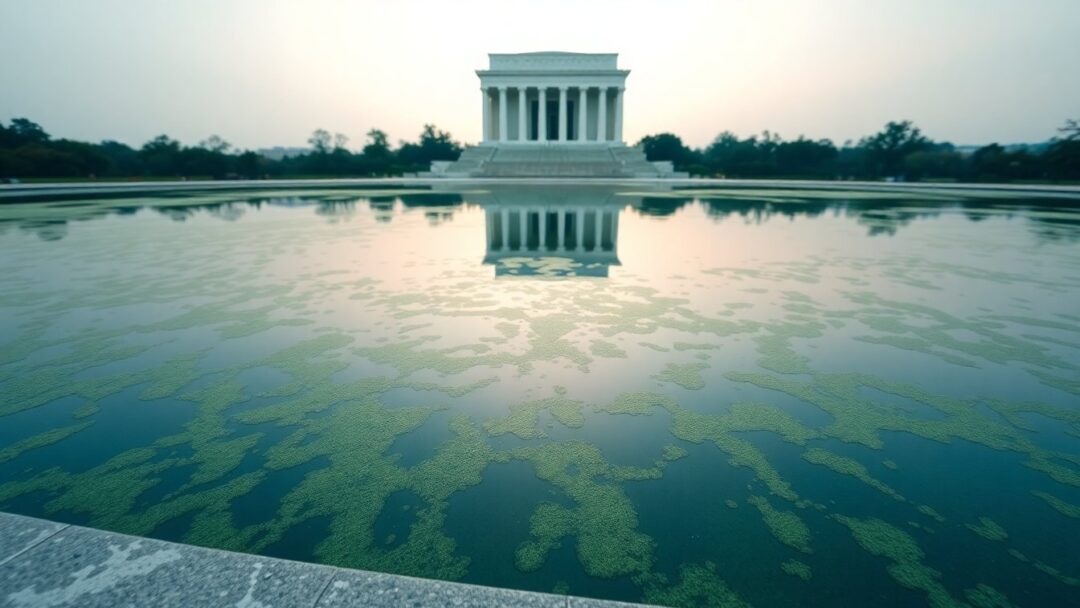
The Lincoln Memorial Reflecting Pool in Washington, D.C., has become the center of a controversy involving allegations of vandalism and ongoing maintenance issues. President Donald Trump has taken to social media to express his concerns and blame unknown individuals for the damage.
The reflecting pool, which underwent a $14.8 million renovation project, has been the subject of scrutiny due to the appearance of algae growth and peeling paint just weeks after its completion. The pool, a significant landmark between the Washington Monument and the Lincoln Memorial, has been a point of pride for the Trump administration, which has emphasized its efforts to beautify the nation’s capital.
Allegations of Vandalism and Chemical Damage
President Trump has accused vandals of using chemicals to damage the newly installed surface of the reflecting pool. In a post on Truth Social, he stated, “No different than the chemicals that were used on the National Mall, they used something similar in the Reflecting Pool to try to destroy and demean our beautiful work.” The allegations come amid reports of a large “86 47” message etched into the grass near the National Mall, which administration officials have characterized as threatening.
The numbers “86 47” are believed to refer to the removal of Trump as the nation’s 47th president. The incident has raised concerns about the security and maintenance of national monuments in Washington, D.C. The National Park Service and contractors have deployed chemicals and ozone nanobubbles to mitigate the algae growth, and workers have used a swimming pool-style vacuum system to remove algae from the bottom of the pool.
Ongoing Investigations and Cleanup Efforts
Law enforcement agencies are actively investigating the alleged vandalism. Images and videos posted on social media have shown National Guard personnel and U.S. Park Police officers patrolling the area. Additionally, videos have surfaced showing people gathered near the reflecting pool, criticizing the renovation project and celebrating the algae growth.
President Trump has stated that most of the algae has been removed and that the vandalized area will be repaired by next week. He also mentioned that the algae problem is “75% gone” and that the damage is limited. The National Park Service has assured the public that there are no harmful side effects to marine life or the environment from the cleanup efforts.
The Broader Context of National Monument Maintenance
The issues at the Lincoln Memorial Reflecting Pool come at a time when the Trump administration has been focusing on the beautification and maintenance of national monuments. The reflecting pool’s renovation was part of a broader effort to prepare for the nation’s 250th anniversary celebrations. However, the recent incidents have highlighted the challenges of maintaining such iconic sites.
Experts have noted that algae blooms are common in shallow, sun-exposed bodies of water, particularly during periods of heat. The reflecting pool’s design and environmental conditions make it susceptible to such issues. Despite the challenges, the administration has emphasized its commitment to restoring and maintaining the pool’s condition.
As the investigation into the alleged vandalism continues, the Lincoln Memorial Reflecting Pool remains a symbol of both the beauty and the challenges of preserving national landmarks. The incident has sparked a broader conversation about the importance of protecting and maintaining these historic sites for future generations.


