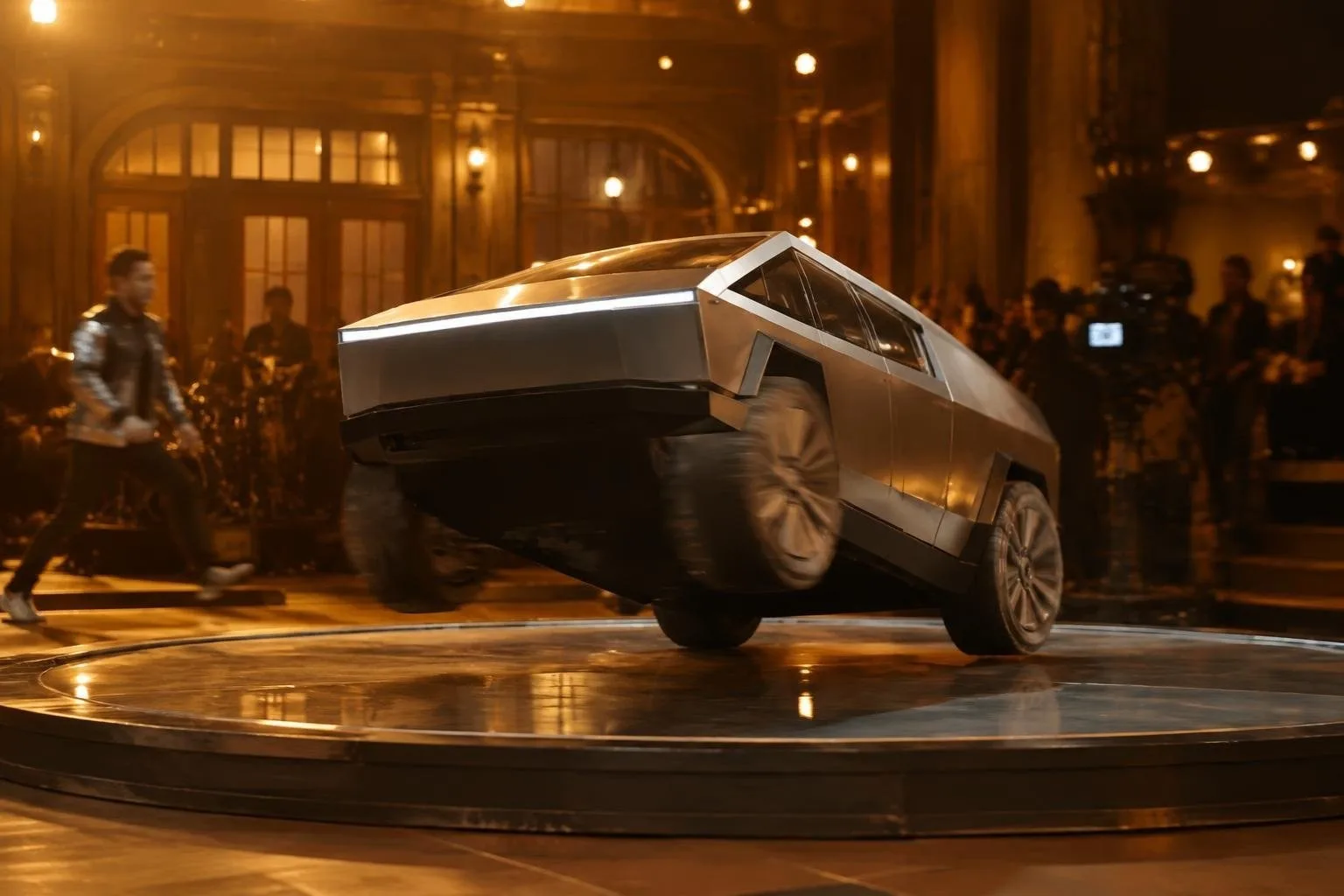
Elon Musk poured nearly $500 million into the 2026 U.S. midterm races, predominantly backing Republican candidates in Texas and beyond. The monetary barrage failed to translate into victories; most of the politicians he supported were either defeated or saw their margins shrink dramatically. The fallout coincided with the publicized mishap of the Cybertruck, which flipped during a demonstration and was disparaged as a “Hot Wheel-like” stunt. These twin setbacks placed Musk under intense media scrutiny, prompting late-night shows to craft material around his recent losses.
Saturday Night Live seized the moment during its Weekend Update segment, featuring featured player Jeremy Culhane as a bewildered Musk. Host Colin Jost opened the bit by pointing out the billionaire’s recent headline: “you wasted half a billion dollars on the midterms.” The fictional Musk promptly pivoted, insisting the real story was his flipped truck, delivering a stream of disjointed “imagine” interjections reminiscent of his real-life press appearances. The dialogue spiraled into a series of non-sequitur remarks, each punctuated by the catch-phrase “epic vulgar roast,” which the sketch framed as a feature of Musk’s AI assistant, Grok.
Musk’s political outlay and the electoral backlash
The 2026 midterms have set a new benchmark for private campaign contributions, with total spending projected to approach $12 billion. Musk emerged as the single largest individual donor, channeling funds into Senate, House, and gubernatorial races across the nation. Despite his aggressive financing, the political map shifted in ways that undercut his objectives: several Texas statewide contests flipped Democratic, and key Republican incumbents he championed fell short. Analysts noted that the sheer scale of his involvement may have backfired, casting him as a polarizing figure rather than a decisive power broker.
Beyond the ballot box, the backlash extended to Musk’s industrial ventures. The Cybertruck—once touted as a revolutionary electric pickup—suffered a high-profile failure when a prototype performed a spectacular rollover during a live demonstration. Critics seized on the incident, labeling the vehicle a vanity project and questioning the viability of Musk’s broader automotive roadmap. The confluence of political defeat and product embarrassment amplified the narrative that even the world’s richest person is vulnerable to public missteps.
The SNL sketch: satire meets self-parody
In the SNL bit, Culhane’s Musk repeatedly attempted to divert attention from the electoral loss, launching into a manic recollection of the truck flip and invoking a series of vague, grandiose visions. Jost, playing the straight-man, highlighted the irony of Musk’s migration from California to Texas—a move originally justified by opposition to “blue” policies—only to confront a “red-state” backlash of his own. When asked how he felt about Texas turning blue, the faux Musk replied with a flat “Bad,” then immediately scrambled back to his trademark rambling.
The sketch’s climax featured a fabricated exchange with the AI chatbot Grok, which supposedly generated an “epic vulgar roast.” The AI’s lines—”You’re the worst thing South Africa has ever done,” “When you’re on TV it feels like an episode of ‘Hate on the Spectrum,’” and “If you have 100 more kids, maybe one will talk to you”—served as a meta-commentary on Musk’s controversial online persona. By having Musk request and then chastise his own AI-generated insults, the skit underscored how the billionaire’s public statements often appear self-inflicted.
Wider cultural implications and future outlook
The SNL appearance adds a new layer to the ongoing discourse surrounding Musk’s influence. A four-hour Alex Gibney documentary released earlier this fall dissected the entrepreneur’s mythos, arguing that his flamboyant public stunts mask a more dangerous concentration of power. The sketch’s restrained yet precise performance—contrasting with the 2025 Mike Myers cameo—suggests that SNL may be recalibrating its approach to controversial figures, opting for sharper satire rather than outright celebration.
Looking ahead, Musk has announced a pause in Cybertruck production to reallocate resources toward autonomous “Cybercabs.” Whether this pivot will restore confidence in his automotive ambitions remains to be seen. Meanwhile, his political aspirations appear stalled; the midterm debacle has already fueled speculation that Musk might double-down on corporate lobbying instead of direct campaign contributions. As the billionaire continues to dominate headlines—whether for AI controversies, satellite deals, or celebrity caricatures—the SNL roast stands as a reminder that even the world’s wealthiest can become fodder for late-night comedy.